Skip to content

Interactive guide

How to sell research peptides online

Most of selling research peptides online is ordinary e-commerce: a catalog, a checkout, parcels and email. What is different is how closely it is watched. This guide shows the promises a store has to keep on every page, and how to grow without breaking them.

  • 13 min read
  • 1:26 video
  • Updated
Chapters · jump to any step

Overview

Promise

Catalog

Checkout

Grow

Read the narration

Selling research peptides online isn't like selling anything else. Payment providers, ad platforms and regulators all look harder, so a good store keeps a few promises on every page.

First, research use only. It's on the banner, on the label and on every product page, and the copy describes the product: its size, its batch and its testing. Never an effect, a dose or a result.

Next, a catalog that tells the truth. Every size gets its own page and its own stock. Tiers are priced in the basket, and the certificate on the page is the one for the batch you ship.

Then, checkout keeps your rules: a minimum order and free delivery from a threshold, checked when the order is placed. Take payment through a provider that knows what you sell. Photograph every order at the bench, and when you tick dispatched, the tracking goes out on its own.

To grow, advertise only what each platform allows, and email only the people who asked. And when someone asks how to use it, the answer is research use only, every time.

My-Pepts builds these promises into your store. Start your store at my-pepts.com.

Selling research peptides online: the promises a store keeps

Maya and Sam talk it through

The recording is on its way. The full conversation is below.

Read the conversation
Maya
Welcome to the My-Pepts guides podcast. I'm Maya, and like my co-host, I'm an AI voice reading a script written from this guide.
Sam
And I'm Sam. Today: selling research peptides online. And the first thing the guide says is that most of it is ordinary.
Maya
It is. A catalog, a checkout, parcels, emails. What's different is how closely it's watched. Payment providers, ad platforms and regulators all look harder at this trade.
Sam
How much harder?
Maya
LegitScript, a firm that monitors this for payment companies, counted online ads for what it calls problematic peptides up 308 percent in 2024 on the year before. And on one day in August 2026, the FDA sent warning letters to five online peptide sellers.
Sam
Whose labels all said research use only, I'm guessing.
Maya
Exactly. The FDA judged each site as a whole: dosing content, reconstitution calculators, mixing water sold alongside. The label didn't change the outcome. New Zealand's regulator says that wording has no legal effect. Austria's calls it irrelevant under pharmaceutical law.
Sam
So the guide's first promise is research use, but true, not just printed.
Maya
Right. On the banner, the label, every product page and checkout. And the copy describes the product: its size, its batch, its testing. Never an effect, a dose or a result.
Sam
And there's a little copy checker in the article, which I enjoyed far too much.
Maya
Paste in a product description and it flags dosing, effects, medical claims and testimonials. The bad example has everything: a fat-loss claim, before-and-after photos, a free mixing kit.
Sam
Every warning letter in one paragraph. What about reviews? They're everywhere in e-commerce.
Maya
Fake reviews, and reviews that hide they were paid for or rewarded, have been banned in the UK since April 2025, and the competition regulator can fine up to ten percent of global turnover. In the US, the FTC's rule carries penalties of up to fifty-three thousand dollars per violation.
Sam
Okay. Promise two?
Maya
A catalog that tells the truth. Every size gets its own page, its own price and its own stock. Volume tiers are priced in the basket, so the badge never promises more than the checkout gives.
Sam
And the certificate?
Maya
Is the one for the batch you actually ship. Same lot number on the paper and on the vial.
Sam
Promise three is checkout.
Maya
A minimum order and free delivery from a threshold cover your costs on small baskets. But show them early. Baymard's research puts average cart abandonment at about seventy percent, and among people who weren't just browsing, forty percent left because of extra costs.
Sam
And the UK regulator's first fine for breaking consumer law under its new powers was for exactly that, wasn't it?
Maya
A fee that only appeared at checkout. Four point two million pounds. So the cart should say how close a shopper is to free delivery, not ambush them at the end.
Sam
Getting paid. This is the one people worry about.
Maya
With reason. Stripe prohibits incorrectly labeled research chemicals. PayPal UK prohibits products that present a risk to consumer safety. Shopify Payments prohibits products with health claims no regulator has verified.
Sam
So read the lists before you build around one.
Maya
And ask in writing. One more thing worth knowing: card chargebacks are a card scheme thing. A Faster Payment can't be canceled once it's sent, which is why customers want to trust you before they pay.
Sam
Then the parcels.
Maya
Photograph every order at the bench, so a missing-item message is answered in seconds, and send the tracking the moment the parcel leaves. In Narvar's survey of US shoppers, forty-five percent said that when something goes wrong, they want updates before they have to ask.
Sam
Last part: growing. Ads first.
Maya
Google's healthcare policy bans unapproved substances regardless of any claims of legality, and its review reads the landing page as well as the ad. Repeat violations mean strikes: a three-day hold, then seven days, then suspension.
Sam
Meta? TikTok?
Maya
Meta bans unsafe substances at its own discretion. TikTok bans drugs for enhancement, performance or weight loss, in ads and on landing pages. So the guide's advice: read each platform's policy for what you sell, and if it bans your products, don't advertise them there. Where ads are allowed, make no claims, and show reviewers the same page shoppers see. Even then, approval isn't guaranteed.
Sam
And email?
Maya
In the UK, marketing email to individuals normally needs consent. The exception, the soft opt-in, needs a sale, your own similar products only, and an opt-out offered when you took the address and in every message. An opt-out in the order confirmation is too late.
Sam
And order emails themselves?
Maya
Service messages, fine to send. But add a promotion and the regulator treats it as marketing.
Sam
And when a customer asks how to use what they bought?
Maya
The answer is research use only. Every time. And if the message suggests they mean to use it on themselves, the order is canceled and refunded.
Sam
That's it from us. The checklist at the end of the article covers everything before you open, and every source is linked under it.
Maya
Thanks for listening.

The short version

  1. 01

    Research use has to be true, not just printed

    Regulators in the US, the UK, Austria and New Zealand have said a label alone decides nothing. They read your copy, your posts and what you sell alongside.

  2. 02

    Describe the product, never the effect

    Size, batch and testing: yes. Effects, doses, results and before-and-after: never, anywhere on the store or its social accounts.

  3. 03

    Show every cost before checkout

    Extra costs are the top reason shoppers who meant to buy give up at checkout. Let the cart say how close they are to free delivery.

  4. 04

    Get paid by someone who knows what you sell

    Big providers restrict research chemicals and unverified health products. Read their lists, ask in writing, and know that card chargebacks do not apply to bank transfers.

  5. 05

    Grow within the rules

    Advertise only where a platform's policy allows what you sell, make no claims, and email marketing only to people who agreed to it.

On this page

The whole picture

A store that keeps its promises

Most of selling research peptides online is ordinary e-commerce: a catalog, a checkout, parcels and email. What makes it different is how closely it is watched. Payment providers screen the stores they serve, ad platforms read the pages their ads lead to, and regulators read whole sites, social posts included.

  • 308%

    more online ads for problematic peptides in 2024 than in 2023

    Counted by LegitScript, a monitoring firm that writes screening guidance for payment processors. It lists “not for human consumption” labeling among its red flags.[1]

  • 5

    FDA warning letters to online peptide sellers on one day in August 2026

    Their labels said research use only. The FDA judged each site as a whole, from its dosing content to the mixing water sold alongside.[2,3]

  • No legal effect

    is what New Zealand's regulator says research-only wording has

    Austria’s regulator calls such labels irrelevant under pharmaceutical law.[8,7]

None of that makes the trade impossible. It means a store has to keep a few promises on every page, and keep them for real: research use only, a catalog that tells the truth, rules that hold at checkout, and growth that stays inside the lines. Tap the markers on a demo store below to see where each promise lives.
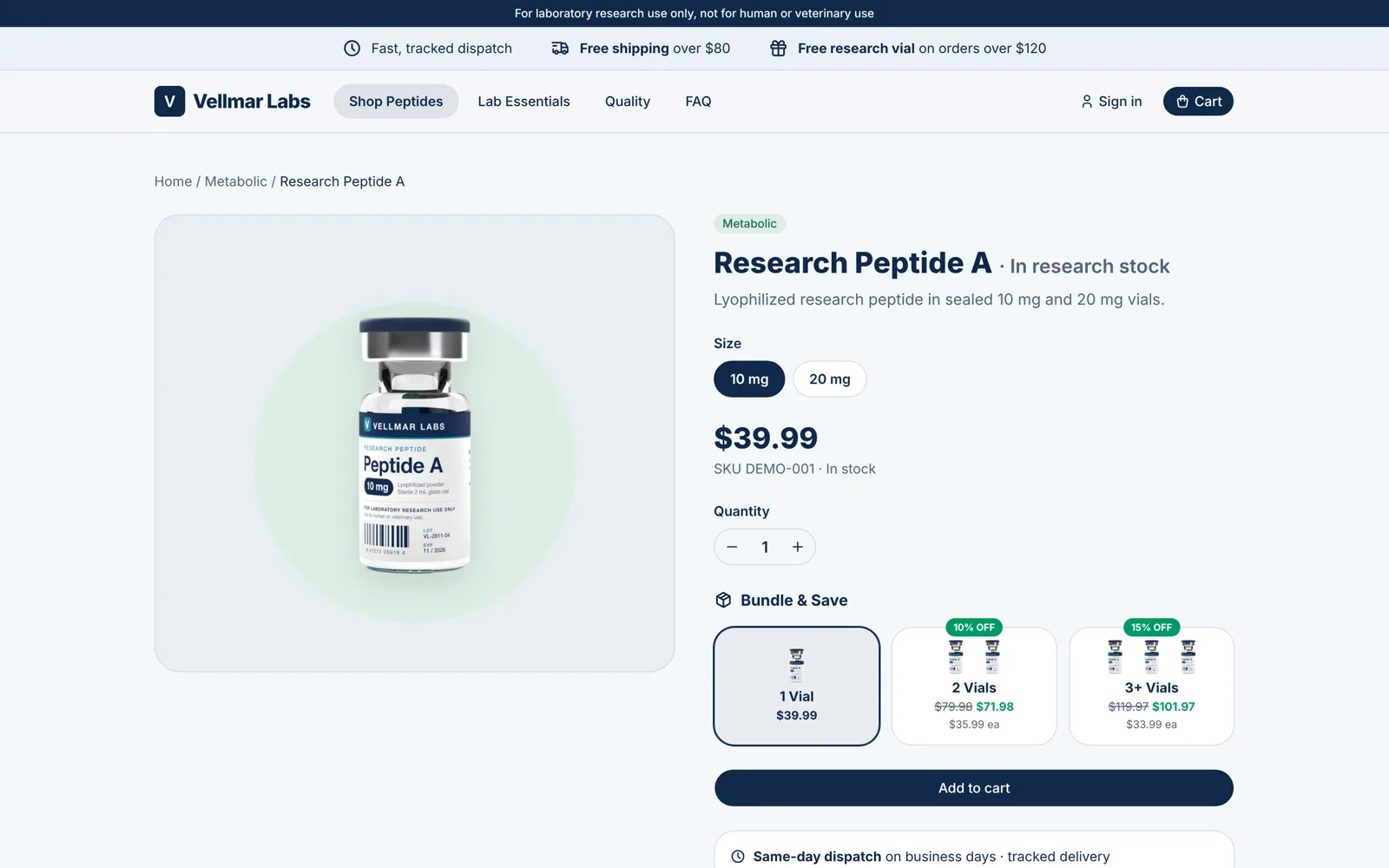
A product page on a demo lab's store: the research use banner, delivery thresholds, a vial, two sizes, the price and stock, Bundle & Save tiers and the dispatch promise.

Stop 1 of 7

Research use, on every page

The first line of every page says what the products are for. It is the store keeping the same promise its terms make, not a disclaimer tucked in the footer.

What research use only asks of a store

Part 1

Research use, everywhere

Not a line in the footer, but a promise the whole store keeps: the banner, every label and product page, checkout, your emails and your social accounts.

A research-use line protects nothing on its own. In its 2026 warning letters the FDA found products were meant for people despite labels reading research use only and not for human consumption, because the rest of each site said otherwise: dosing content, reconstitution calculators, mixing water in the same basket.[2,4,3] An earlier letter quoted the seller’s Facebook post, so social accounts count as part of the store.[5] The UK’s MHRA has said it disregards “research purposes” claims used to get around medicines rules,[6] and Australia’s regulator has warned that influencers and affiliates may be held accountable for unlawful advertising too.[9]

Payment screeners read stores the same way. LegitScript’s guide for payment processors says stores that prominently state their products are not for human consumption are, “perhaps counterintuitively, more likely to be engaged in unapproved peptides sales”, and it looks for safeguards that keep personal-use buyers out.[10] So the line is never enough on its own: everything else on the store has to agree with it.

Do

  • Say research use only on the banner, the label, every product page and at checkout
  • Ask buyers to confirm research use and their age before they pay
  • Describe products as what they are: size, form, batch, testing, storage
  • Hold your social accounts, emails and affiliates to the same words

Never

  • Effects, results, doses or before-and-after photos
  • Dose calculators, or mixing supplies sold beside the products
  • Reviews or posts about personal use, yours or a customer's
  • Advice to a customer about how to use a product

Try it

Check your copy

Paste a product description below, or try the two examples. The checker marks the five kinds of words that turn a research listing into something else: human use, dosing, effects, medical claims and testimonials.

Nothing you type is saved or sent. A word list cannot judge context: treat each mark as a line to reread.

Nothing flagged

Research Peptide A, lyophilized powder in a sealed 10 mg vial. Batch RA10-2609-B, HPLC purity 99.1% on the certificate of analysis for this batch. For laboratory research use only, not for human or veterinary use. Store at -20 °C, away from light.

Human use · 0Dosing and mixing · 0Effects and benefits · 0Medical claims · 0Testimonials · 0

It describes the product: what it is, its size, its batch and its testing. That is all a research listing needs to say.

The rules behind it are old and plain. In the UK, the advertising code allows medicinal claims only for licensed medicines and for medical devices with the right conformity marking.[11] In the US, the FTC expects health claims to rest on competent and reliable scientific evidence, usually human clinical trials, and says a disclaimer will not cure an otherwise deceptive ad.[12]

ReviewsReviews and testimonials

Fake reviews, reviews that hide that they were paid for or rewarded, and misleading review information have been banned in the UK since 6 April 2025, and a store that publishes reviews must take steps to keep them out.[15] The Competition and Markets Authority can now fine a business directly, up to 10% of its global turnover or £300,000, whichever is greater.[16] In the US, the FTC’s rule against fake reviews and testimonials, including AI-written ones, took effect in October 2024,[13] with penalties of up to $53,088 per violation.[14]

For a research store there is a simpler rule still: a review about how a product made someone feel is a claim about personal use. Leave it off.

Paperwork

A short list of what a UK online store has to show, and where. Other countries have their own versions; the shape is usually the same.

Who you areYour business details

Your name, the geographic address you trade from, an email address for quick contact, your company registration number and, if you have one, your VAT number, all easy to find from every page.[18] A limited company also shows its registered name, where it is registered, its number and its registered office address on its website.[19]

PricesPrices, delivery and the total

Before an order, show the total price and the delivery cost, or how they are worked out, and make it clear that placing the order means paying. After it, confirm the order in writing and deliver within 30 days unless you agreed otherwise.[20] The Competition and Markets Authority’s first fine for breaking consumer law under its new powers, £4.2 million in April 2026, was for a fee that only appeared at checkout.[17]

ReturnsCancellations and returns

A consumer can usually cancel an online order within 14 days of receiving it, and longer if you never told them they could. Goods sealed for health protection or hygiene reasons lose that right once unsealed, and business buyers are not covered at all.[21] Say in your terms how this applies to your products, and to labs buying as businesses.

TermsTerms that say research use

Your terms of sale are where research use only becomes a condition of the sale, not a slogan: who may buy, what they confirm at checkout, and that you will not advise on use. Have them reviewed by a lawyer who knows your market.

Part 2

A catalog that tells the truth

Sizes, stock, tiers and certificates are where a store most often promises more than it can deliver. Kept as data, they cannot drift.

  1. 01

    Give every size its own page

    Keep a size as data, not as words in a title. Each one gets its own price, its own stock and its own address, so a link to the 20 mg size opens on the 20 mg size, and a limit per size stops one basket emptying the shelf.

    The rule: A shopper sees what is really in stock, in the size they want, before they pay.

    In My-Pepts: Every size has its own page, price, stock and limit, with Bundle & Save tiers set per size.
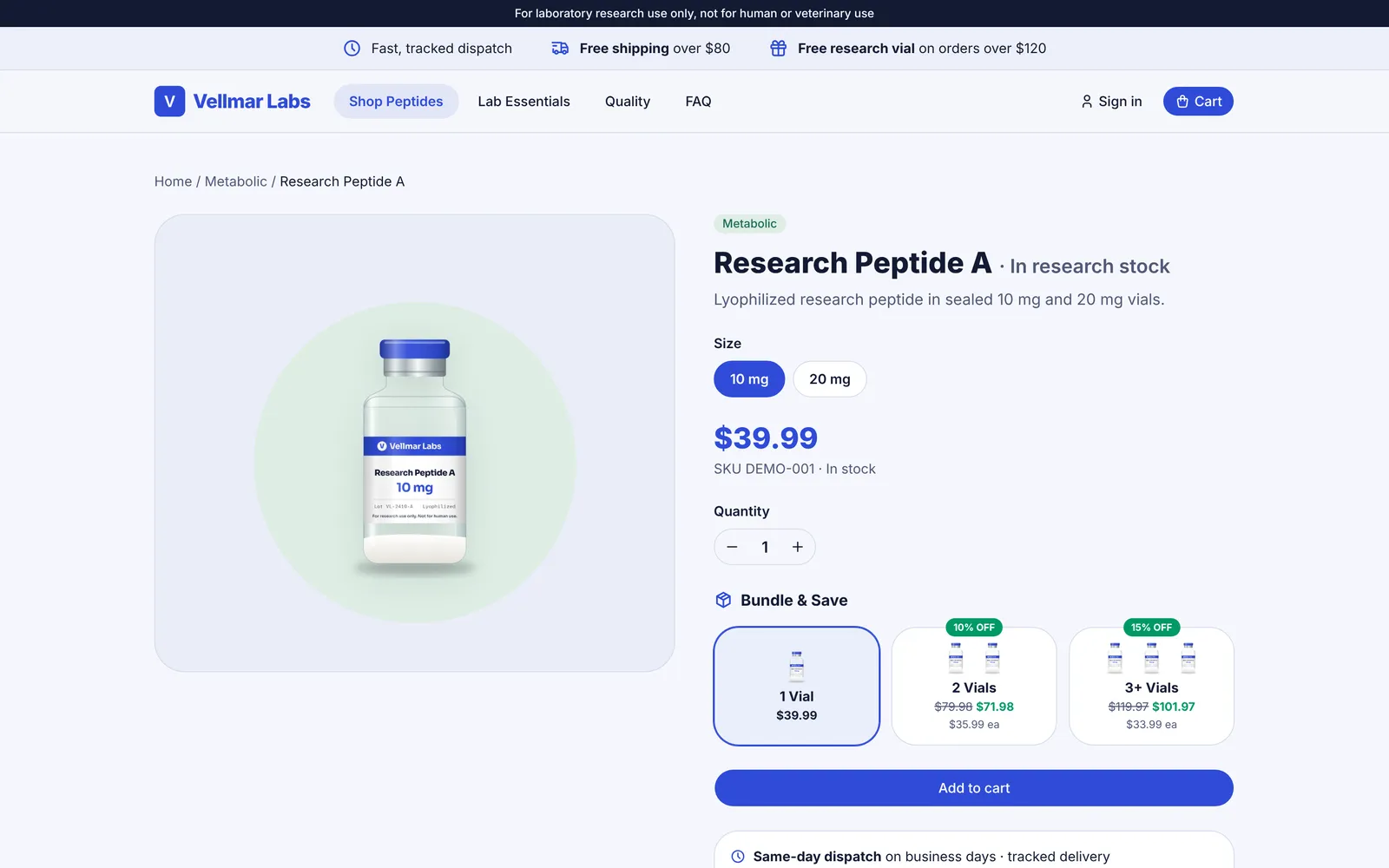
    A Vellmar Labs product page with the 10 mg size selected, its own address ending in /10mg, a limit of 5 per order, three Bundle & Save tiers (1 vial, 2 vials at 10% off and 3 or more at 15% off) and a note that only 3 are left.
  2. 02

    Show the certificate for the batch you ship

    Tie each certificate to the batch it covers and the date of its test, and show only the ones you hold. Two kinds are common, the manufacturer's certificate and an independent test you commission yourself; say which is which.

    The rule: The certificate on the page covers the batch in the parcel, and nothing on the page claims more than it shows.

    In My-Pepts: Upload the manufacturer's certificate and blur its private fields in your browser before it is saved; independent results sit beside it once you file a test.

  3. 03

    Stay private until every page is ready

    Build the catalog, write the copy and try the checkout behind a password, then open in one go. Every page carries the research use line before anyone outside sees it.

    The rule: Nothing goes public before every page says research use only.

    In My-Pepts: A password wall keeps the whole store private while you set it up, and one switch in the admin opens it.
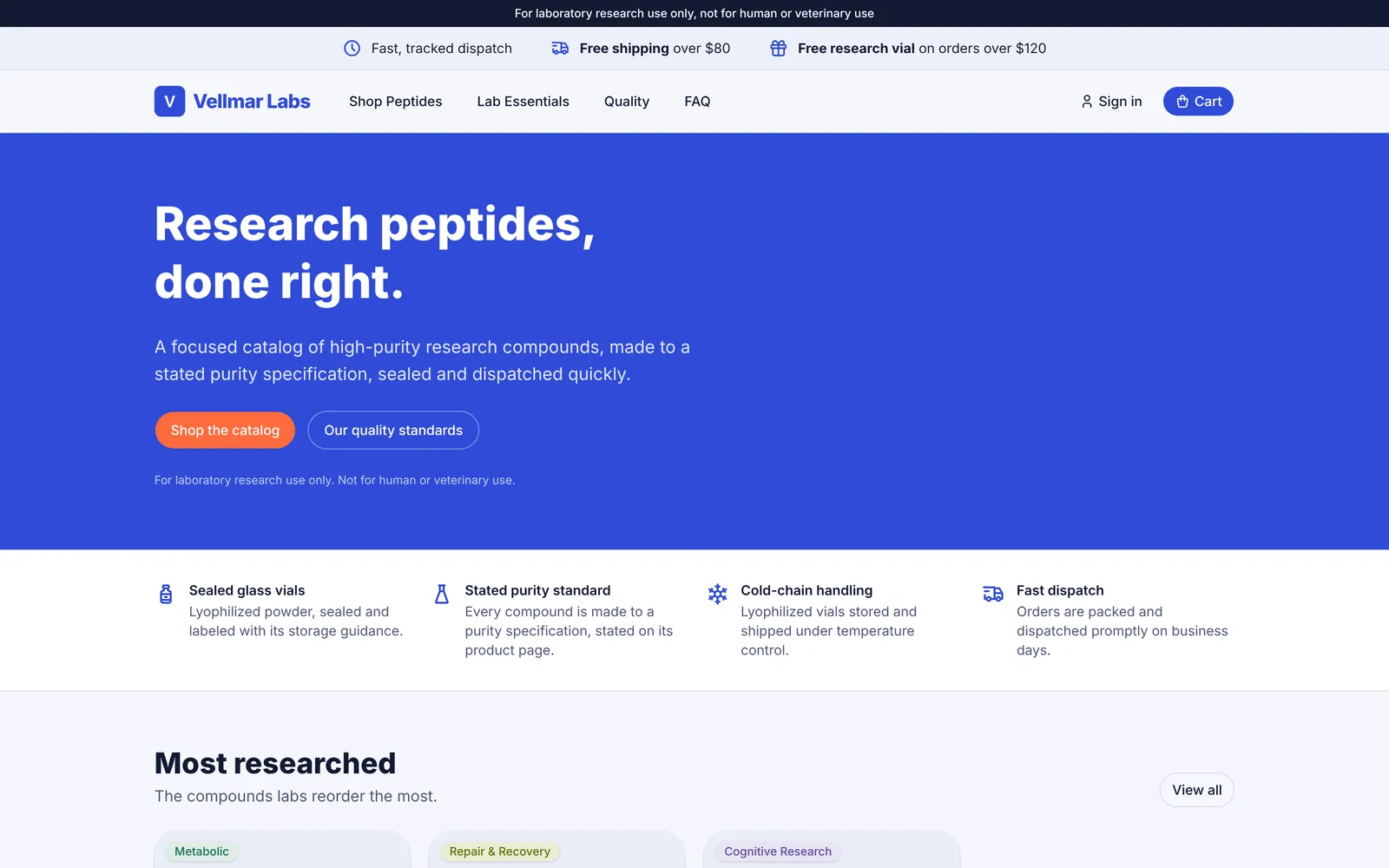
    The Vellmar Labs store home, with its banner on every page reading For laboratory research use only, not for human or veterinary use. A password wall covers the store: This store is in private preview, with an access password field and an Enter button.

Try it

Tiers that add up

Volume tiers are a fair way to reward a lab that buys several vials. They go wrong when a badge promises more than the basket gives. Change the tiers below and watch the basket price each quantity, and the badge check that “Save up to” is true.

What one to six vials cost with these tiers
VialsBasketEachSaved
1$39.99$39.99None
210% off$71.98$35.99$8.00
315% off$101.97$33.99$18.00
415% off$135.97$33.99$23.99
515% off$169.96$33.99$29.99
615% off$203.95$33.99$35.99

“Save up to 20%” overclaims. No basket gets more than 15% off with these tiers. Change the badge or the tiers until they agree.

The same rule as delivery: the price a shopper sees on the page is the price they pay at checkout, with nothing added later.[20]

Part 3

Checkout, payment and delivery

Rules that cover your costs, a way to get paid that will last, and parcels that answer questions before they are asked.

  1. 01

    Let checkout enforce your rules

    A minimum order, a delivery charge and a free-delivery threshold cover your costs on small baskets. They only hold if checkout checks them when the order is placed, and the cart should say how close a shopper is rather than refuse them at the last step.

    The rule: No order is ever placed under rules you have changed.

    In My-Pepts: Set a minimum order, a free shipping threshold and a free gift threshold in the admin; checkout applies them, and the cart shows shoppers how close they are to each.

Try it

Rules shoppers can see coming

Baymard Institute puts the average online cart abandonment rate at about 70%. Among shoppers who were not just browsing, the top reason was extra costs such as delivery, at 40%, and 12% left because they could not see the total up front.[22] So say your rules early. Set them below, add items, and watch the cart tell the shopper how close they are.

  • Research Peptide A, 10 mg$39.992
  • Research Peptide A, 20 mg$69.990
  • Storage box for 10 vials$9.990

Your store’s rules

What checkout sees

Subtotal
$79.98
Delivery
$6.95
Total
$86.93
  • Add $0.02 for free delivery.
  • Add $40.02 for a free research vial.
  • Ready to check out.

Getting paid

A way to get paid that lasts

Losing a payment provider stops a store taking money, so read its rules before you build around it. Stripe prohibits incorrectly labeled research chemicals, and pseudo-pharmaceuticals that are not safe or make harmful claims.[23] PayPal UK prohibits products that present a risk to consumer safety.[24] Shopify Payments prohibits products with health claims no regulator has verified.[25] Describe what you sell plainly, ask in writing, and keep the answer.

Bank transferWhat bank transfer means for you and your customers

A UK Faster Payment usually arrives almost at once, though it can take up to two hours, and once sent it cannot be canceled.[26] Chargebacks are a way to challenge card payments,[27] so a customer paying by transfer is trusting you more. Earn it: clear terms, an order confirmation the moment they pay, and tracking the moment it ships.

On My-Pepts, lab stores take bank transfer, plus pay by bank in the UK.

  1. 02

    Pack against the order, with photos

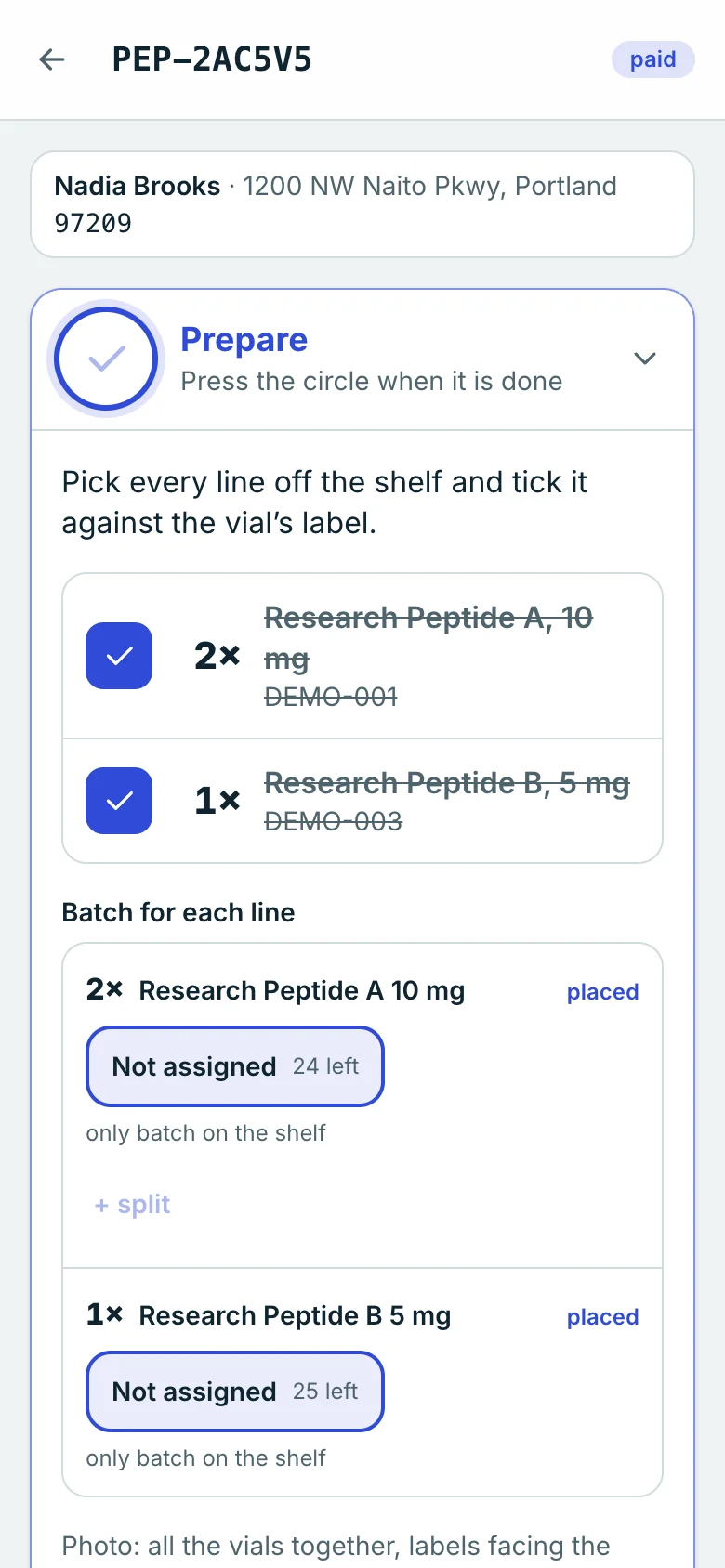
    Tick each line against its vial's label, then photograph the prepared vials together, the packed box and the labeled parcel. A photo answers a "something was missing" message in seconds, and records which batch went out.

    The rule: Every parcel can be shown, and traced to its batches.

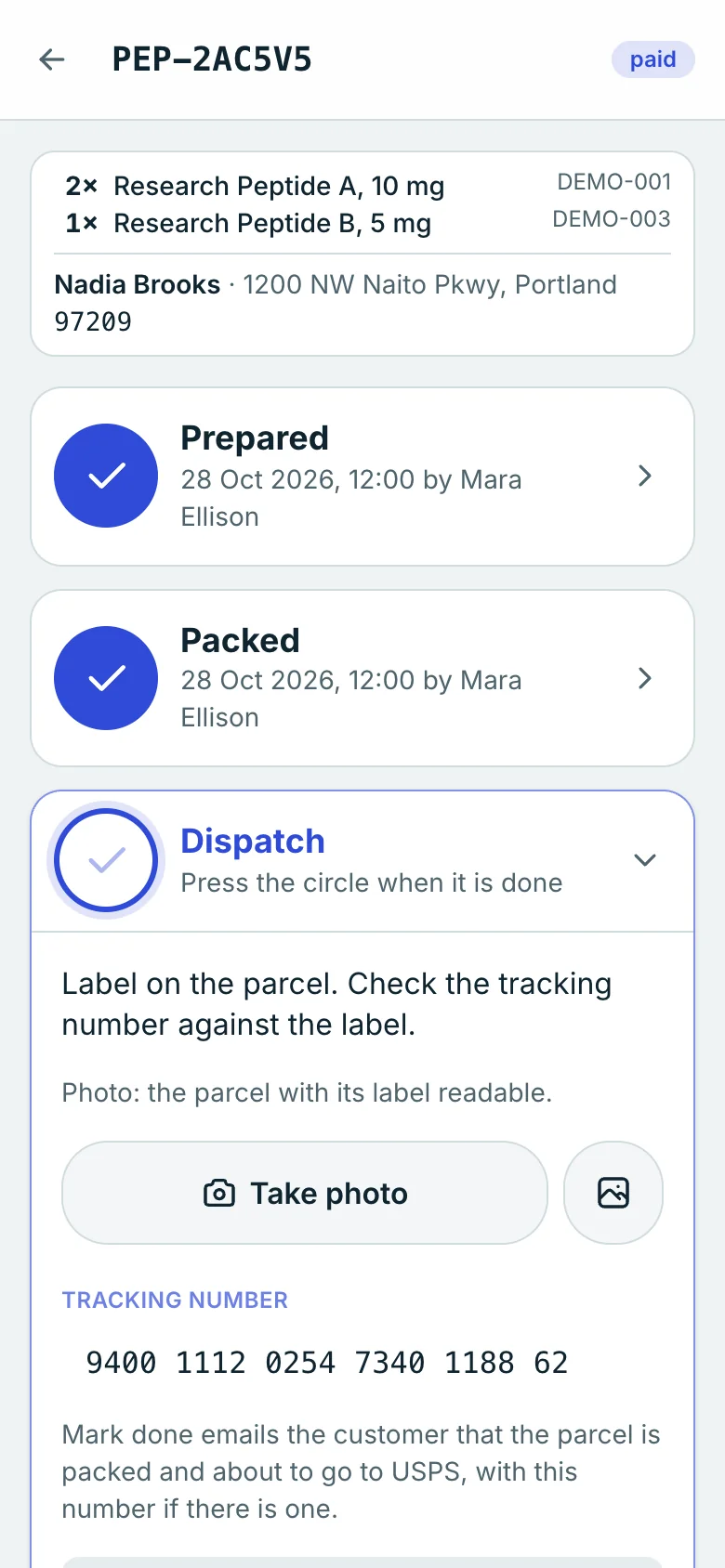
    In My-Pepts: Scan the order's QR code and it opens on your phone: Prepared asks for a photo of the vials, Packed for the box, Dispatched for the labeled parcel and its tracking number.
  2. 03

    Send the tracking the moment it exists

    Tell the customer the parcel is on its way, with its tracking number, as it leaves. Then pass the carrier's updates on in your own name, so "where is my order?" is answered before it is asked.

    The rule: Every dispatched order has emailed its tracking number.

    In My-Pepts: Tick Dispatched and the customer is emailed in your store's name, tracking number included. On Growth and up, Royal Mail's own updates are passed on in your words.

Part 4

Growing within the rules

Ads, email and replies can grow a store or end it. The difference is which pages they lead to, and who they go to.

  1. 01

    Advertise only what the platform allows

    Ad review reads the ad and the page it leads to. Read each platform's policy for what you sell; if it bans your products, don't advertise them there. Make no claims, and show reviewers exactly the page shoppers see. Approval is never guaranteed.

    The rule: Every ad runs where the platform's policy allows what you sell, and neither the ad nor its page makes a claim.

    In My-Pepts: Paid search lands on a research-use-only page that makes no claims, and checks in our code test its text before every release.Growth and up

  2. 02

    Email only the people who asked

    Build marketing lists only from people who agreed to hear from you, and check that agreement again at the moment you send, because people change their minds. Order emails are different: every customer gets those.

    The rule: No marketing email reaches anyone who did not agree to it.

    In My-Pepts: Campaigns only ever reach people who subscribed, and consent is checked again at the moment of sending.Growth and up

  3. 03

    Answer with the order in front of you

    Many messages are about a parcel, a certificate or a payment, and each is quick to answer with the order on screen. "How do I use this?" gets the research-use answer, every time, and if a message suggests use in people or animals, cancel and refund the order.

    The rule: A person reads every reply before it is sent.

    In My-Pepts: Claude drafts a reply with the customer's orders, tracking and earlier messages in view, and every draft waits for you to press Send.

Advertising

What ad platforms check

None of the big ad platforms names research peptides in its rules, but their wording reaches them. Google’s healthcare policy bans unapproved substances regardless of any claims of legality, including products subject to a regulator’s action or warning.[29] Its review covers the destination as well as the ad, so the landing page is reviewed too.[30] Meta bans ads for substances it judges unsafe, at its sole discretion.[32] TikTok bans ads and landing pages that promote drugs for enhancement, performance or weight loss.[33]

Google’s repeat-violation ladder

  1. Warning

    The ads come down. Nothing else, the first time.

  2. Strike 1

    A repeat after the warning: a 3-day hold on the account.

  3. Strike 2

    Another within 90 days: a 7-day hold, the final notice.

  4. Strike 3

    The account is suspended.

Each policy gets one warning and three strikes at most. The second and third strikes count repeats within 90 days of the last strike.[31]

Try it

In the UK, marketing email to an individual needs their consent, with one exception for a business: the soft opt-in. It covers your own similar products, sent to someone who gave you their address while buying or asking to buy, and who was offered a free way to say no then and in every message since.[34] The opt-out has to come when you collect the address; one in the order confirmation is too late.[35] Order and dispatch emails are service messages, but any promotion inside one makes it marketing.[36] Pick an email and a person:

The email
The person

Don't send it

The opt-out has to be offered when the address is collected. One in the order confirmation is too late.

The UK rules for email to individuals, simplified. Not legal advice; other countries differ.

CookiesCookies and ad tags

Ad tags need a visitor’s consent before they run. UK rules now allow analytics used only to improve your own site without consent, as long as visitors are told and can object for free, but online advertising always needs it.[37] Since 5 February 2026 the maximum fine for breaking the UK rules on cookies or marketing email is £17.5 million or 4% of worldwide turnover, whichever is higher, up from £500,000.[39,38]

USSelling to the US

CAN-SPAM lets you email without prior consent, but every marketing email needs an honest subject line, your postal address and a working opt-out, honored within 10 business days, with no exception for email to businesses. Each email that breaks the rules can cost up to $53,088.[40]

Try it

Answering customers

Many messages to a research store are about a parcel, a certificate or a payment, and each is quick to answer with the order on screen. One is different every time: “how do I use this?” gets the research-use answer, kindly and without exceptions, and if a message suggests the products are meant for use in people or animals, cancel the order and refund it. Sort the inbox below.

Have on screen

  • The order's status and the date it was dispatched
  • The tracking number and the carrier's latest scan
  • Any delivery email the carrier already sent

A reply that keeps to research use

Your parcel left us on Tuesday and the carrier scanned it this morning; it is due tomorrow. Here is the tracking link so you can follow it. If it has not arrived by Friday, reply here and we will look into it with the carrier.

Summing up

Before you open

Ten things to have in place before the first order. Tick them off as you go; each links back to its section.

0 of 10 ready

0%
Questions labs ask

Short answers. The sections above have the detail.

Is it legal to sell research peptides online?

It depends on where you are, what you sell and how you sell it, and this guide is not legal advice. What regulators agree on is that they judge the whole site: the FDA, the UK's MHRA, Austria's regulator and New Zealand's have all said a research-use label does not decide it on its own. Take advice for your country before you open.

Does a "research use only" disclaimer protect my store?

Not by itself. FDA warning letters found products intended for people despite research-use labels, because of the dosing content and mixing supplies on the same sites. One firm that writes screening guidance for payment processors even says stores that prominently disclaim human use are more likely to be selling unapproved peptides. The line has to be true of everything else on the store.

Can I advertise research peptides on Google, Meta or TikTok?

Approval is never guaranteed. Google bans unapproved substances regardless of claims of legality and reviews the landing page as well as the ad, with strikes leading to suspension. Meta bans unsafe substances at its own discretion, and TikTok bans drugs for enhancement, performance or weight loss in ads and on landing pages. If a platform's policy bans what you sell, don't advertise it there; where ads are allowed, make no claims and show reviewers the same page shoppers see.

Which payment providers accept research peptide stores?

Each provider decides for itself. Stripe prohibits incorrectly labeled research chemicals, PayPal UK prohibits products that present a risk to consumer safety, and Shopify Payments prohibits products with health claims no regulator has verified. Ask in writing before you rely on one. My-Pepts lab stores take bank transfer, plus pay by bank in the UK.

Do I need customers' consent to email them?

For marketing in the UK, usually yes. The exception, the soft opt-in, needs a sale or real negotiation for one, marketing of your own similar products only, and an opt-out offered when you collected the address and in every message. Order and dispatch emails are service messages, but adding a promotion makes them marketing. In the US, CAN-SPAM requires an opt-out honored within 10 business days and a postal address.

Can customers return research peptides?

In the UK, consumers can usually cancel an online order within 14 days of receiving the goods, but goods sealed for health protection or hygiene reasons lose that right once unsealed, and business buyers are not covered. Say how it applies to your products in your terms.

Sources

The numbers in brackets point here. Rules and policies change; check the source before you rely on one. This guide is general information, not legal advice.

  1. 1.Problematic peptides market: LegitScript data findings · LegitScript, December 2025. Vendor monitoring data, percentages only
  2. 2.Warning letter to Peak Performance Peptides · US Food and Drug Administration, August 2026. One of five letters sent that day
  3. 3.RUO-ined: Five Peptide Vendors Learn That 'Research Use Only' Is Not a Legal Strategy · ArentFox Schiff, September 2026
  4. 4.Warning letter to Gram Peptides · US Food and Drug Administration, March 2026
  5. 5.Warning letter to Summit Research Peptides · US Food and Drug Administration, December 2024. Cites the seller's Facebook post
  6. 6.Grey-market peptides: what pharmacists need to know · The Pharmacist, 2026. Quotes the MHRA
  7. 7.Peptides: illegal products from the internet with incalculable health risks · BASG, Austrian Federal Office for Safety in Health Care, May 2026
  8. 8.Consumer advisory: unapproved peptide products health warning · Medsafe, New Zealand Ministry of Health, May 2026
  9. 9.Unapproved peptide product promoters and suppliers are put on notice · Therapeutic Goods Administration, Australia, accessed 1 November 2026
  10. 10.Peptides for payment processors guide · LegitScript, October 2025
  11. 11.CAP Code section 12: medicines, medical devices, health-related products and beauty products · Committee of Advertising Practice (ASA), accessed 1 November 2026
  12. 12.Health Products Compliance Guidance · US Federal Trade Commission, December 2022
  13. 13.Federal Trade Commission announces final rule banning fake reviews and testimonials · US Federal Trade Commission, August 2024
  14. 14.16 CFR 1.98: adjustment of civil monetary penalty amounts · Electronic Code of Federal Regulations, July 2026
  15. 15.Fake reviews (CMA208) · Competition and Markets Authority, April 2025
  16. 16.How the CMA uses its direct consumer enforcement powers · Competition and Markets Authority, August 2025
  17. 17.CMA issues multi-million drip pricing fine in enforcement first · Pinsent Masons (Out-Law), April 2026
  18. 18.The Electronic Commerce (EC Directive) Regulations 2002, regulation 6 · legislation.gov.uk, 2002
  19. 19.Company and business names · Business Companion (Trading Standards), May 2026
  20. 20.Online and distance selling for businesses: online selling · GOV.UK, accessed 1 November 2026
  21. 21.The Consumer Contracts (Information, Cancellation and Additional Charges) Regulations 2013 · legislation.gov.uk, 2013
  22. 22.Cart abandonment rate statistics · Baymard Institute, September 2025
  23. 23.Prohibited and restricted businesses · Stripe, September 2026
  24. 24.Acceptable Use Policy (UK) · PayPal UK, October 2026
  25. 25.Shopify Payments eligibility · Shopify Help Center, accessed 1 November 2026
  26. 26.How Faster Payments work · Pay.UK, September 2024
  27. 27.Common myths about section 75 and chargeback · Financial Ombudsman Service, accessed 1 November 2026
  28. 28.2025 State of Post-Purchase report · Narvar, November 2025. Survey of 3,461 US online shoppers
  29. 29.Healthcare and medicines · Google Ads policy help, accessed 1 November 2026
  30. 30.About the ad review process · Google Ads policy help, accessed 1 November 2026
  31. 31.About enforcement procedures for repeat violations · Google Ads policy help, accessed 1 November 2026
  32. 32.Unsafe supplements (advertising standards) · Meta Transparency Center, accessed 1 November 2026
  33. 33.TikTok advertising policies: dangerous products or services · TikTok, April 2025
  34. 34.The Privacy and Electronic Communications (EC Directive) Regulations 2003, regulation 22, as amended · legislation.gov.uk, amended February 2026
  35. 35.How do we comply with the PECR electronic mail marketing rules? · Information Commissioner's Office, October 2026
  36. 36.Identify direct marketing · Information Commissioner's Office, May 2026
  37. 37.Guidance on the use of storage and access technologies: what are the exceptions? · Information Commissioner's Office, accessed 1 November 2026
  38. 38.The Data (Use and Access) Act 2025 (Commencement No. 6 and Transitional and Saving Provisions) Regulations 2026 · legislation.gov.uk, January 2026. Brings the higher fines into force from 5 February 2026
  39. 39.Data (Use and Access) Act 2025, Schedule 13 · legislation.gov.uk, June 2025. Applies the higher maximum to the cookie and marketing email rules
  40. 40.CAN-SPAM Act: a compliance guide for business · US Federal Trade Commission, accessed 1 November 2026

The easy part, done for you

Your store, your admin and the tools to buy stock with care, in one place.

Start your 14-day trial