Skip to content

Interactive guide

How to start a research peptide store

Opening the store is the easy part, and this guide walks it step by step. Then comes the part that decides whether a store lasts: choosing suppliers, reading a certificate, testing a batch, and limiting what one bad supplier can cost you.

  • 14 min read
  • 1:26 video
  • 8 min podcast
  • Updated
Chapters · jump to any step

Overview

Launch

Stock

Read the narration

Opening a research peptide store used to take months. With My-Pepts, it takes an afternoon.

Sign up and pick a plan. Name your store, and it's live on its own address in seconds, with its own database and admin. Put your name, your mark and your colors on it. Turn the sample listings into your products, sizes and prices. Connect your domain and your email, and you're ready for orders.

That's the easy part. The hard part is what goes in the vials. Stock from a supplier nobody checked can be the wrong compound, filled short, or contaminated, and you can't see any of that in the powder. Lose a batch, and it costs you money. Sell one, and it can cost you your customers, your payment account and your name.

So buy with a routine. Shortlist suppliers who show independent testing. Compare prices per vial. Ask for the certificate for your exact batch, and check the lot number and the lab yourself. Start with a small order, paid in a way you can dispute. Book it in, batch by batch. Send one vial to an independent lab, and list it only when your own result agrees.

Setting up takes minutes. Buying well takes care. My-Pepts helps with both. Start your store at my-pepts.com.

Starting a peptide store: the easy part and the hard part

Maya and Sam talk it through · 7:42

Read the conversation
Maya
Welcome to the My-Pepts guides podcast. I'm Maya, and like my co-host, I'm an AI voice reading a script written from this guide.
Sam
And I'm Sam. Today: how to start a research peptide store. Which, it turns out, is really two jobs.
Maya
Right. Job one is the store. Job two is what goes in the vials. And they could not be more different.
Sam
Let's do the easy one first. What does opening the store actually involve now?
Maya
With My-Pepts, about 20 minutes of your own time. You create an account and pick a plan. You name the store, choose its address, country and currency, and within seconds it's live, with its own database and its own admin.
Sam
Seconds.
Maya
Seconds. Then you put your name, your mark and your colors on it, and one theme carries them through the storefront, the checkout and the order emails. You turn the sample listings into your own products, sizes and prices. Then you connect a domain and set up email, so receipts come from your own address.
Sam
And the waiting bits, like the domain records?
Maya
They happen in the background, and the admin checks them for you. So: an afternoon on the calendar, and twenty minutes of actual work.
Sam
There's a short list of things nobody can do for you, though.
Maya
Four. A registered business and its paperwork. A way to get paid, because mainstream card processors are cautious here: Stripe, for example, prohibits incorrectly labeled research chemicals. So read a provider's rules before you build around it, and be open with your bank about what you sell.
Sam
Third?
Maya
Research use that's true of the whole store. And this is the one people underestimate.
Sam
Because the label isn't enough.
Maya
Not on its own. In its warning letters to research peptide sellers, the FDA looked past the label at everything else: disease claims, dosing guidance, dose calculators, mixing water sold alongside. The UK regulator has said much the same. And a 2024 review found the research-use line on thirty-eight of forty sites, with none of them checking who was buying.
Sam
So the line has to be true of the whole store, not just printed on it.
Maya
Exactly. And the fourth is borders: know the import rules where you are before you place an order.
Sam
Okay. Job two. The hard part.
Maya
The hard part is that you can't see what's in a vial of white powder. Identity, purity, contamination: none of it is visible.
Sam
Give me the numbers, because I think people assume this is rare.
Maya
A peer-reviewed study from 2024 placed test orders with six online sellers of one widely sold peptide. Three never shipped at all. They took the money, then asked for up to twelve hundred dollars more to clear customs.
Sam
That's half.
Maya
Half. The three vials that did arrive were seven to fourteen percent pure, against ninety-nine percent claimed. Each held about thirty to forty percent more than its label said. And one had raised endotoxin.
Sam
More than the label? That sounds almost generous.
Maya
It's still wrong. Too much is as much a failure as too little, because the label a customer relies on is wrong either way.
Sam
Small study, though.
Maya
Very small, and the authors say so. But it lines up with other evidence. One testing service that publishes its results grades samples against a strict bar: at least ninety-nine and a half percent pure, the fill within thirty-five percent of the label, and the right compound. About one in three of the latest two hundred results at one of its labs missed it. Buyers choose what to send, so it's not a market rate. But it tells you a listing's numbers are a claim until someone tests them.
Sam
You mentioned endotoxin. Explain it like I'm not a chemist.
Maya
Endotoxins are bits of bacterial cell wall. When bacteria die, the fragments stay behind, so a product can carry them long after the bacteria are gone. You can't see them, and many basic test panels leave them out unless you ask.
Sam
Why does it matter so much?
Maya
Because it's how contamination hurts people. In one documented outbreak, factory-contaminated hospital solutions held more than a hundred and seventy times the permitted level. Twenty-eight patients fell ill and five died. Not a peptide product, but the same mechanism, and it's why endotoxin belongs on every certificate you accept.
Sam
Let's talk certificates, then. A supplier sends me a certificate of analysis. Am I done?
Maya
You've started. A certificate is the supplier's claim about one batch, and PDFs can be edited. In one US criminal case, prosecutors said a seller used forged lab certificates. And the WHO found fake products printed with a genuine batch number.
Sam
So what does a good one look like?
Maya
The industry standard, called ICH Q7, says a real certificate shows the batch number, a release date, every test with its limit and the actual result as a number, a signature, and the original manufacturer. If a reseller issues its own, it should attach the original.
Sam
And then?
Maya
Then you check it with the lab that issued it, and match the lot number on the certificate to the one on your vials. The guide has an example certificate you can practice on, including a forged version with the problems planted in it.
Sam
What about the money side? Where does that go wrong?
Maya
Paying is the bluntest risk. The FBI logged over fifty-six thousand complaints of non-payment or non-delivery in 2025, with about half a billion dollars lost. Wires and crypto rarely come back. The FBI can sometimes freeze a wire, but only if it's reported fast. And in the UK, the refund scheme for bank transfer fraud only covers payments between UK accounts.
Sam
So a wire to an overseas supplier...
Maya
Is on you. Which is why the first order should be small, paid with a method that leaves you a dispute route, with the quote and every message saved.
Sam
And customs?
Maya
Parcels do get held. US officers at one port found about five thousand peptide parcels hidden in master cartons and left off the manifest. A refused drug shipment worth twenty-five hundred dollars or less can be destroyed without the option of sending it back. In the UK, seized goods are usually destroyed or sold after forty-five days unless you act. And a seizure usually means the import didn't meet the rules, so find out why before you order again.
Sam
Okay. Put it all together. What's the routine?
Maya
Seven steps. One: shortlist suppliers who show independent testing for the batch you'll receive, who you can identify, and who don't sell for human use. Two: compare prices per vial. A price far below everyone else's is a question, not a bargain. Three: get the certificate for your exact batch, and confirm it with the lab.
Maya
Four: a small first order, paid in a way you can trace. Five: book it in batch by batch, so you always know which customer got which vial. Six: send one vial to an independent lab. Seven: list the batch only when your own result agrees.
Sam
Step six costs money. Is it worth it?
Maya
One US service charges about two hundred and fifty dollars for identity, purity, amount and endotoxin, with results in about two weeks. In the guide's example batch, that's about a tenth of what the stock cost. And testing rarely saves the stock. What it saves is everything after: customers who never get a bad vial, a bank with nothing to look into, and your name.
Sam
Does the drug industry work this way too?
Maya
Its standard asks makers to test the identity of every batch they receive, and to fully test at least three batches before cutting back their own testing. For a store, the simple version is: test every batch, and never list one whose result you don't hold.
Sam
Last question. Where does My-Pepts fit?
Maya
It does the store, in minutes. And it gives you tools for the careful part: price lists matched to your products, stock orders checked against the quote, deliveries booked in by batch, testing rounds that file each result on its batch, and certificates on your product pages. It doesn't sell stock, it doesn't test vials, and it doesn't give legal advice.
Sam
Setting up takes minutes.
Maya
Buying well takes care. The full guide, with the video, the certificate practice and a supplier scorecard, is at my-pepts.com slash guides.
Sam
Thanks for listening.

The short version

  1. 01

    The store is the easy part

    From sign-up to taking orders is about 20 minutes of your time. Save your energy for what goes in the vials.

  2. 02

    Check the batch, not the brochure

    Get the certificate for the exact batch you will receive, confirm it with the lab that issued it, and match the lot numbers.

  3. 03

    Start small, pay safely

    A small first order, paid with a method you can dispute, caps what a bad supplier can cost you.

  4. 04

    Test before you sell

    Send one vial from every new batch to an independent lab. It rarely saves the stock. It saves your customers, your payment account and your name.

On this page

The whole journey

Two jobs that look like one

Starting a research peptide store means doing two very different jobs. The first is the store itself: a site, a checkout, your brand, a domain and email. That used to take months. With My-Pepts it takes about 20 minutes of your time, and Part 1 shows every step.

The second job is the stock: finding suppliers, checking what is really in the vials, and buying in a way that limits what one bad supplier can cost you. Nobody can do that part for you in twenty minutes, and it decides whether a store lasts. Part 2 covers it in plain words, with checks you can run yourself.

Launch the store

About 20 minutes. My-Pepts does the heavy lifting.

Stock it with care

Days to weeks per supplier. This is where judgment matters.

Every stop on the map is a step below: press one to jump to it. Steps with a Watch button play the same moment in the video.

Part 1

Launch your store

About 20 minutes of your own time. The waiting, like your domain's records settling in, happens while you do something else, and we check it for you.

From sign-up to first order

about 20 minutes of your time

0 min · Create your account. Your name, your email and a password, then the plan you want to try. Your 14-day free trial starts straight away.
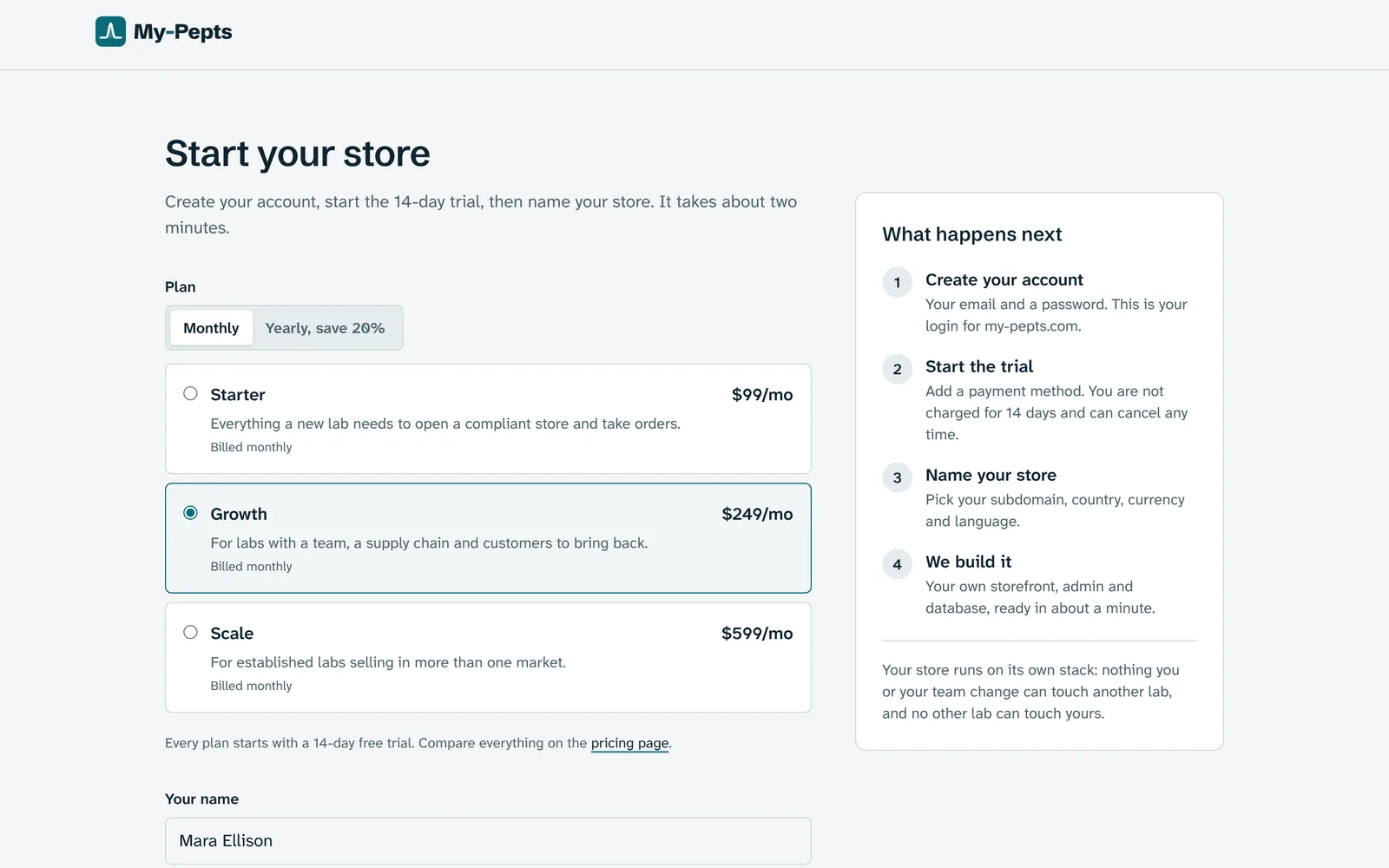
Seven steps, each with what you do and what happens for you. Open “What happens behind the scenes” on any step for the detail.

  1. 01at 0 min

    Create your account

    Your name, your email and a password, then the plan you want to try.
    Your 14-day free trial starts straight away.
    What happens behind the scenes

    Sign-up asks for what it needs and nothing else. You choose a plan, add a payment method for when the trial ends, and land straight in onboarding. Nothing is charged during the trial, and you can cancel any time.

    Compare plans

    The My-Pepts sign-up form: the plan picked (Growth, $249 a month), a note that every plan starts with a free trial, and the name field.
  2. 02at 2 min

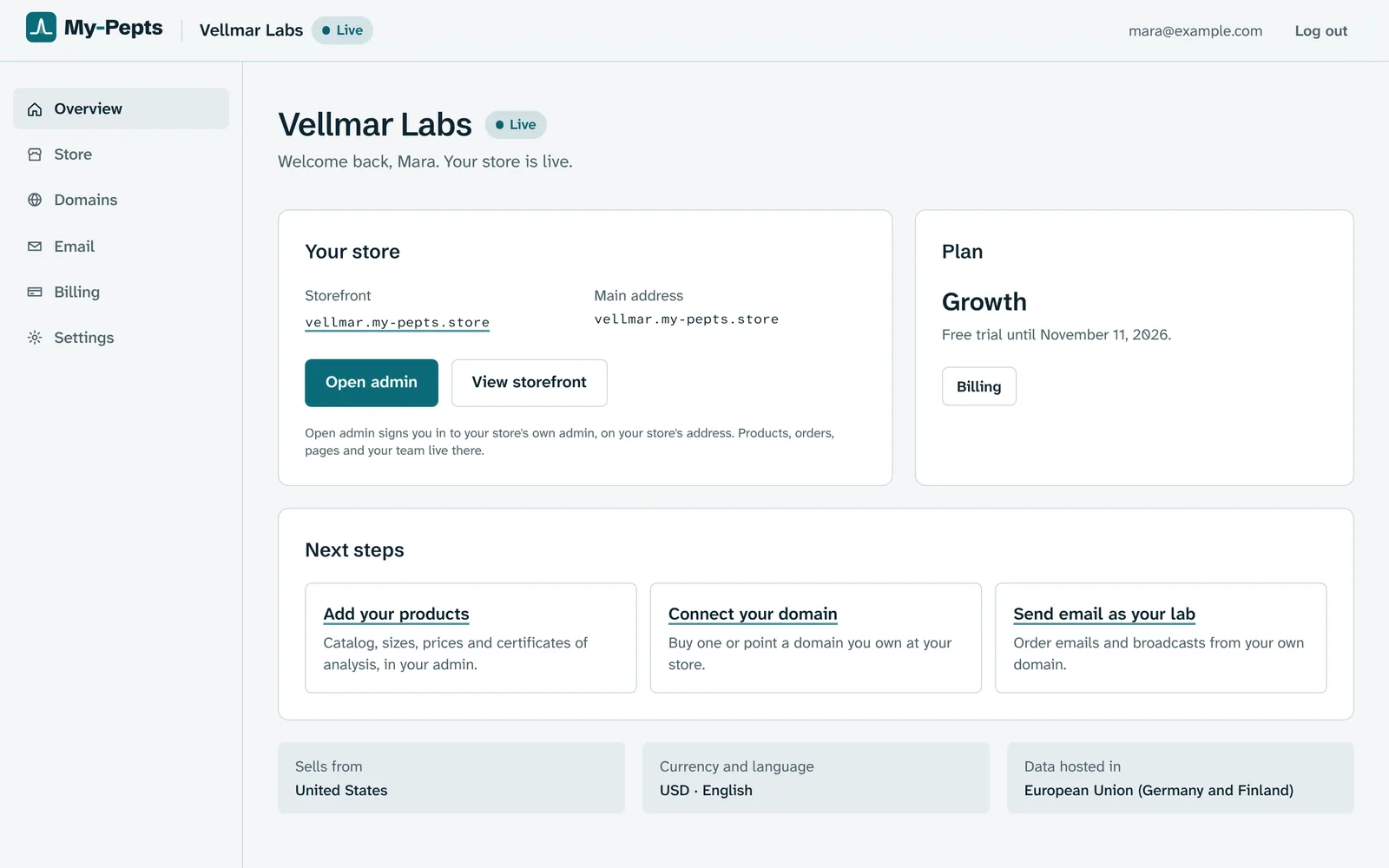
    Your store is live

    Name the store and pick its address, country, currency and language.
    It gets its own database and server, and the storefront and admin open on yourlab.my-pepts.store within seconds.
    What happens behind the scenes

    Onboarding asks for a name, an address and the market you sell in. Provisioning then creates the store's own database, starts its server with its own secrets, and seeds a few sample listings so the storefront is never empty. You watch each step tick off, and the dashboard links straight to the storefront and the admin.

    See the storefront

    The account dashboard for Vellmar Labs marked Live, with the store's address on my-pepts.store and buttons to open its admin and view the storefront.
  3. 03at 3 min

    Brand it

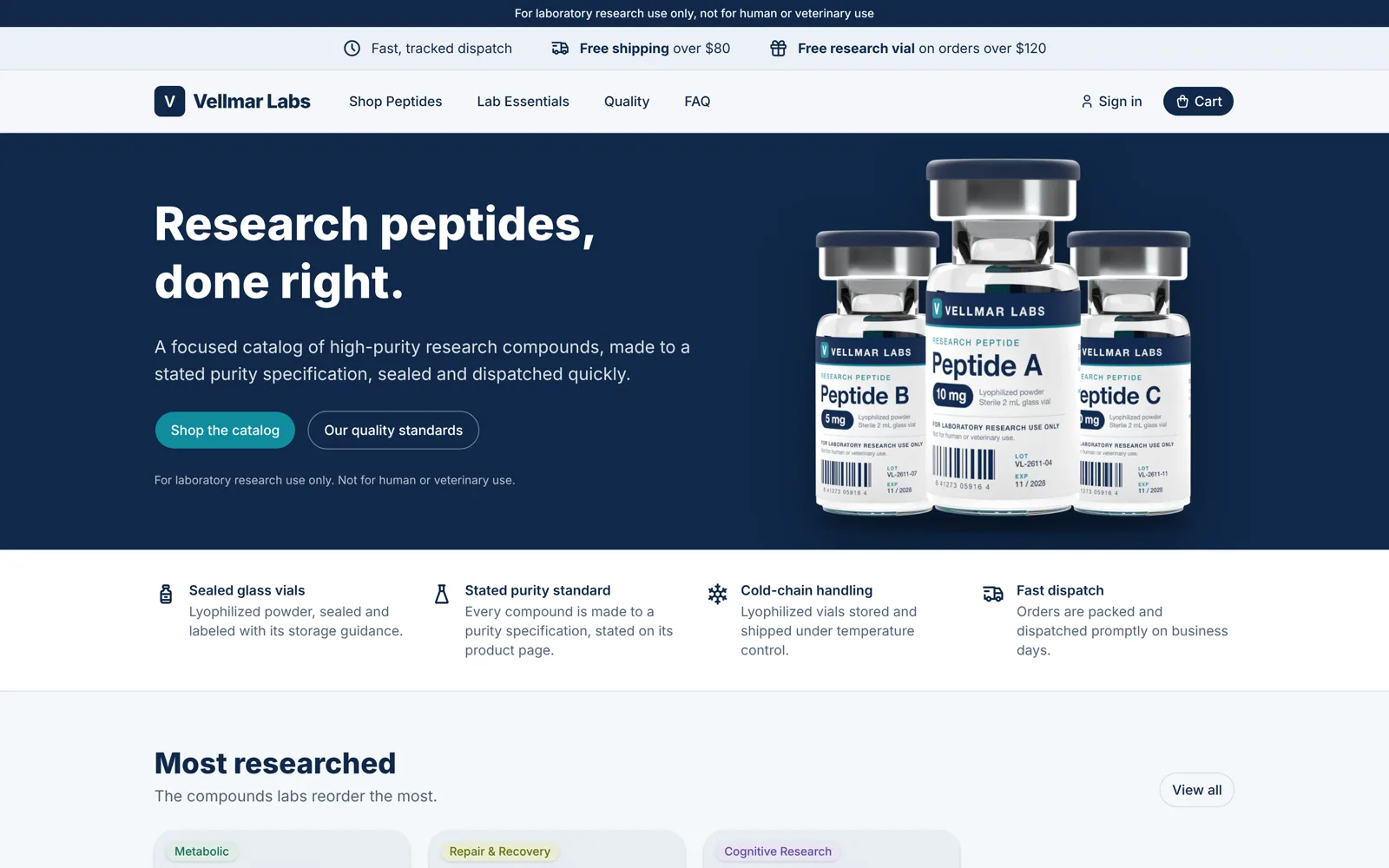
    Put your lab's name, mark and colors on the store.
    One theme carries them to the storefront, the checkout and every order email at once.
    What happens behind the scenes

    From the first page view the store carries your name and a mark made from it, and one theme paints the storefront, the checkout and the order emails. Your own logo and palette go into that same theme, so nothing drifts. Rather hand it off? The branding packages design the kit, the vial labels and the product renders with you.

    See branding

    A lab's storefront in its own navy and white, with its name and mark in the header, a hero line, its vials and a trust strip.
  4. 04at 7 min

    Add your products

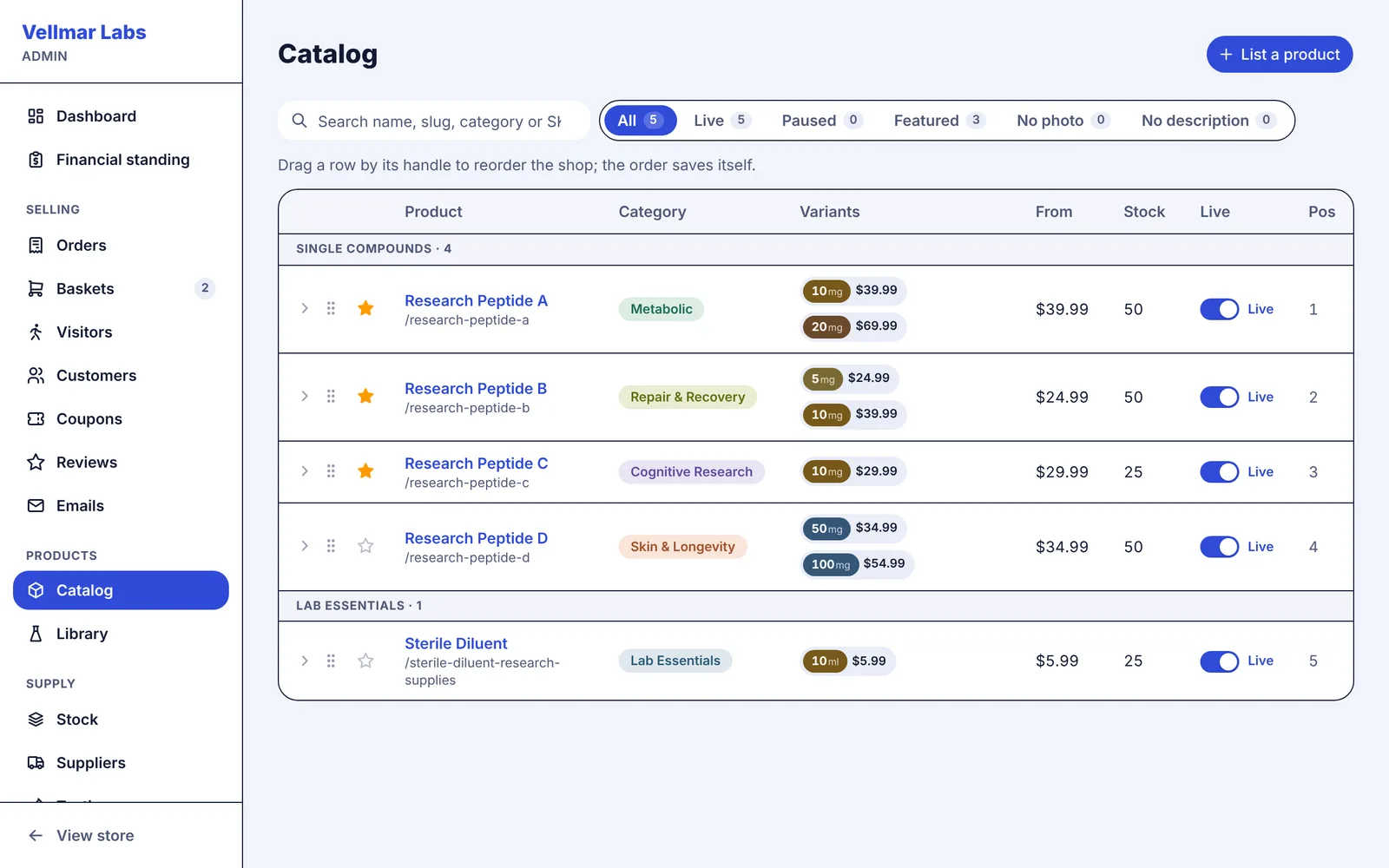
    Edit the sample listings or add your own: sizes, prices, volume tiers and stock.
    Each listing gets a product page with its sizes, prices and the research-use statement.
    What happens behind the scenes

    The catalog is where listings live: sizes with their own prices, Bundle and Save tiers, stock and limits per order, and a photo for each size. The sample listings show every field filled in, so the quickest start is to edit them into your own products and switch them live.

    See product pages

    The catalog in a lab's admin: four research peptides and a diluent, each with its sizes and prices, stock and a Live switch.
  5. 05at 13 min

    Connect your domain

    Buy a domain from the Domains page, or connect one you already own.
    It lists the exact DNS records to add and checks them for you.
    What happens behind the scenes

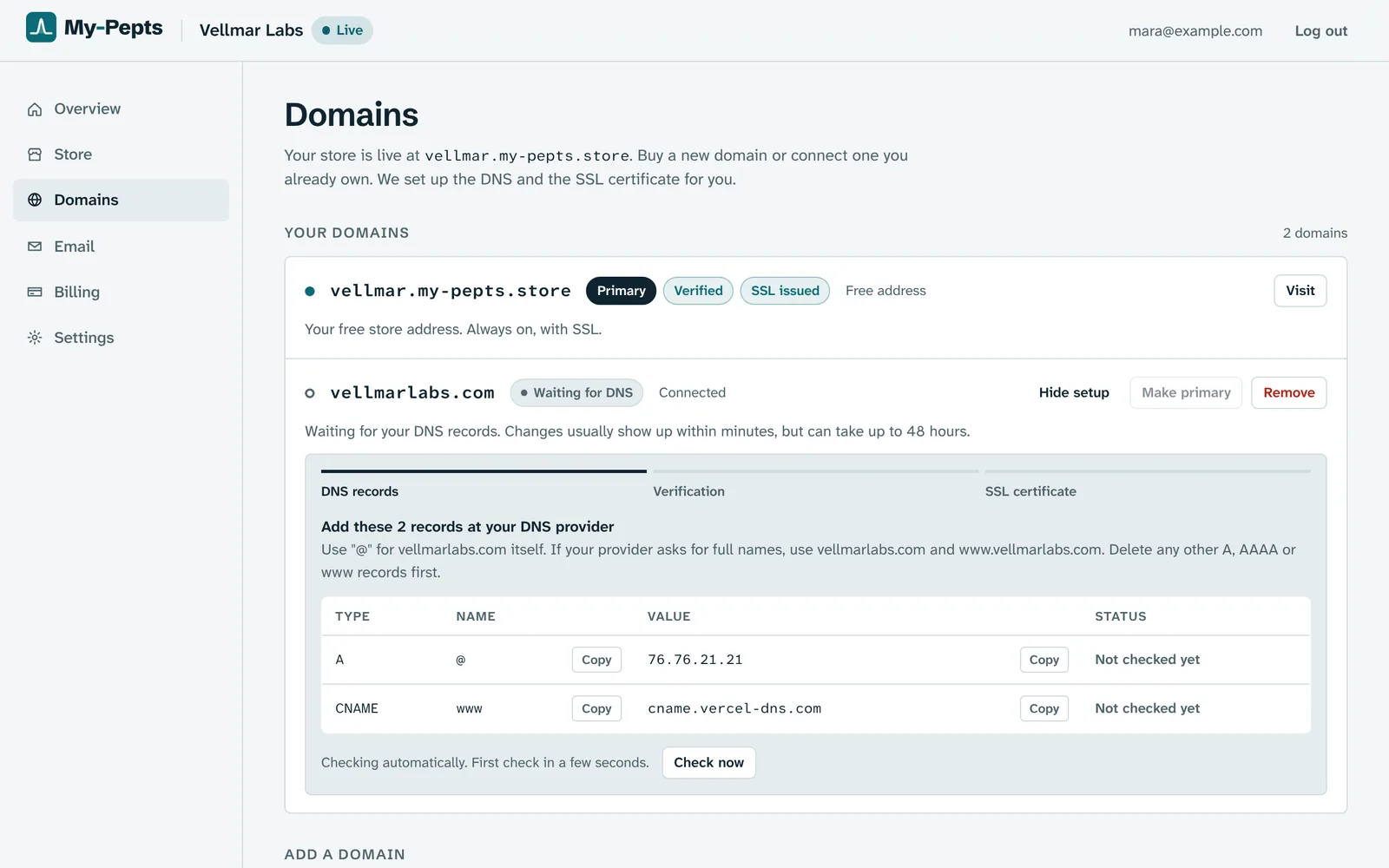
    Buy a domain from the Domains page and the DNS and SSL certificate are set up for you. Already own one? Connect it and the page lists the exact records to add, each with a copy button, then checks them until they are live. Your free address keeps working the whole time.

    The Domains page: the free store address marked Primary, and a lab's own domain waiting for DNS, with the two records to add and a Copy button beside each.
  6. 06at 17 min

    Set up email

    Add the email records the Email page shows you.
    Order confirmations and receipts go out from your own domain.
    What happens behind the scenes

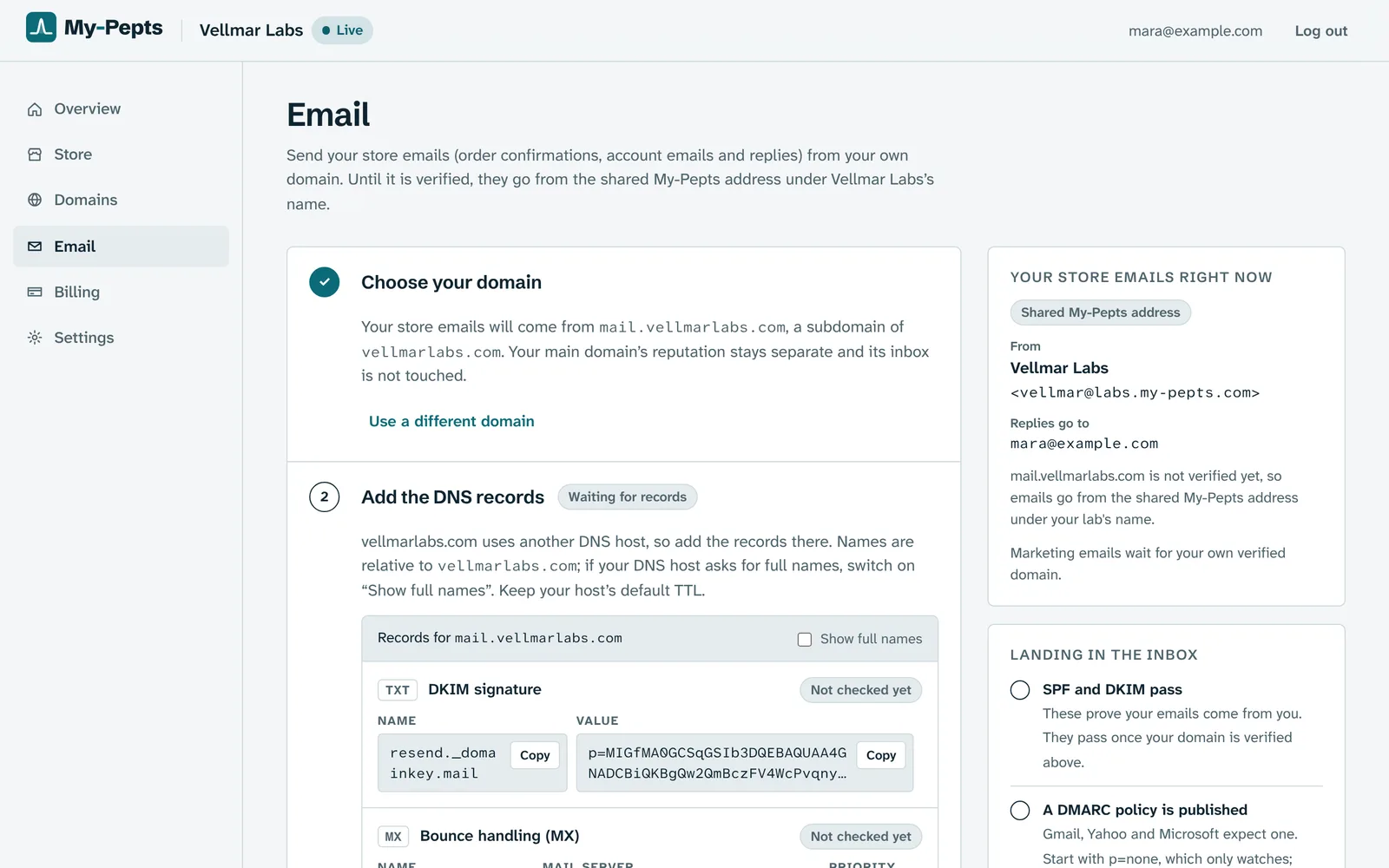
    Until you have your own domain, your store emails go out under your name from a shared My-Pepts address. Once your domain is set up on the Domains page, the Email page sets up sending on a subdomain of it, so your main domain's reputation stays separate. Add the records it shows, switch, and order confirmations, receipts and replies come from your own address.

    See email

    The Email page: step two lists the DNS records for the lab's mail subdomain, and a panel shows what customers see on the store's emails today.
  7. 07at 20 min

    Take orders

    Share your store's link.
    Checkout takes bank transfer, plus pay by bank in the UK, and every order lands in your admin ready to pack.
    What happens behind the scenes

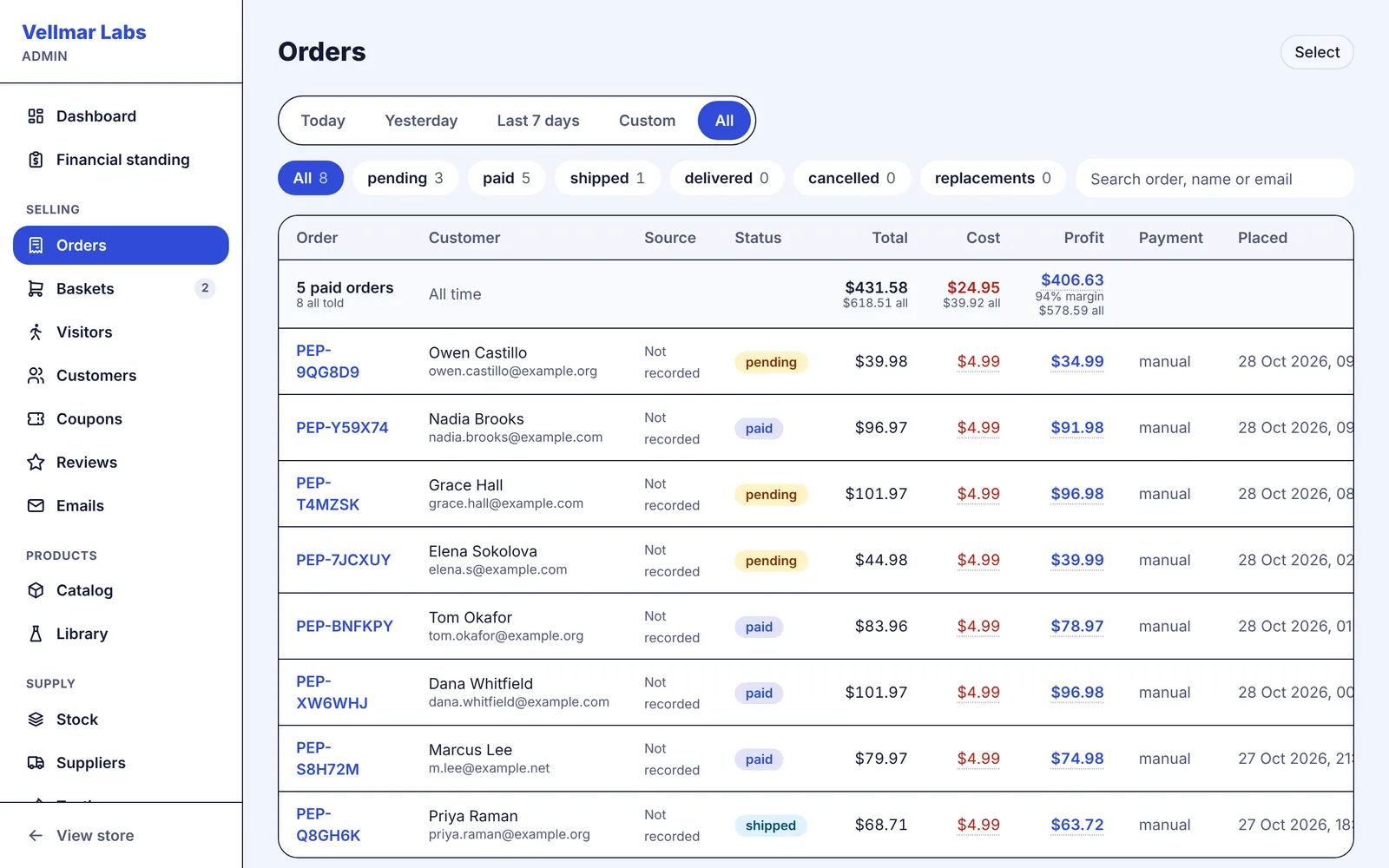
    Checkout follows your rules, takes bank transfer and, in the UK, pay by bank, and asks every buyer to confirm research use. Each order lands in the admin with its cost and profit worked out, and the packing bench on your phone walks it from paid to shipped.

    See order management

    The orders list in a lab's admin: five paid orders this period with their totals, costs and profit, and each order's status and customer.

Before the first order

Four things only you can sort out

My-Pepts builds and runs the store. These four are yours, and they are easier to get right before the first order than after it.

CompanyYour business and its paperwork

Sell through a registered business, put its details on your store’s legal pages, and keep records by batch from the first day. Tax and registration rules differ from country to country, so an hour with a local accountant before launch is money well spent.

WordingResearch use that is true, not just printed

Every product page, label and email should say research use only, and nothing anywhere should undo it. Regulators read the whole store, not just the disclaimer. Keep these off your site and your social accounts:

  • Health, dosing or before-and-after claims
  • Dose calculators, or mixing supplies sold beside your products
  • Reviews and posts that talk about personal use

In its warning letters to research peptide sellers, the FDA pointed to disease claims, dosing guidance, dose calculators and mixing water sold alongside as evidence that the products were meant for people, whatever the label said.[1,2] The UK regulator has said it disregards “research purposes” claims used to get around medicines rules.[3] The line on its own proves little: a 2024 review found it on 38 of 40 sites it examined, and none of them checked who was buying.[4]

PaymentsA way to get paid

Mainstream card processors are cautious with this category. Stripe, for one, prohibits “incorrectly labeled research chemicals” and treats pharmaceuticals sold online as restricted.[5] Read any provider’s prohibited list before you build around it, and make sure what you sell is something its rules allow.

On My-Pepts, checkout takes bank transfer, plus pay by bank in the UK. Whichever way you are paid, be open with your bank about what you sell: an account closed for a surprise is far harder to replace than a conversation up front.

BordersWhere you buy from, and where you ship

If you import stock, the rules where you are decide what may come in, and how. In the UK, for example, importing medicines commercially needs licenses from the MHRA.[6] Know the rules before the first order, ask suppliers for accurate customs paperwork, and if a parcel is ever seized, find out why before you order again. Part 2 shows what a seizure costs.

Part 2

Stock you can trust

The part that decides whether a store lasts. You can't see identity, purity or contamination in a vial of white powder, so you need a way of buying that doesn't rely on seeing it.

  • 3 of 6

    online sellers in a 2024 test buy took the money and never shipped

    Then they asked for up to $1,200 more to “clear customs.” Peer-reviewed, with a small sample.[7]

  • 7 to 14%

    purity of the vials that did arrive, sold as 99% pure

    Each also held 29 to 39% more than its label said. Same study.[7]

  • 1 in 3

    samples missed one testing service's strict standard

    99.5% purity or higher, fill within 35% of the label, the right compound: the latest 200 results at one of its labs. Buyers choose what to send, so this is not a market-wide rate.[8]

None of this is bad luck. It is what buying on trust looks like. The rest of Part 2 is the alternative: follow a vial, see where it can go wrong, then learn the checks that catch each problem.

Follow one vial

Seven stops between the factory and your customer

Each stop is a place something can go wrong, and each has a check that catches it. Press a stop to open it.

Stop 1 of 7 · Manufacturer

Makes the peptide, freeze-dries it and fills the vials. Many research peptides are made overseas and imported.

What can go wrong

The wrong compound, impurities from a rushed process, vials filled short, or contamination from an unclean line.

The check that catches it

A certificate for this batch from an independent lab: identity, purity, amount per vial and endotoxin.

The caveats

What a bad supplier can cost you

Here is what the evidence shows, from peer-reviewed test buys, regulators and court records. Lose a batch and it costs you money. Sell one and it can cost you far more: your customers’ trust, your accounts and your name.

What arrived from six online sellers

Test orders placed in 2024 with six online sellers of one widely sold peptide. A small sample, as the authors say.

  • Never arrived50%

    3 of 6 orders, then a demand for more money

  • Arrived, far below the purity claimed50%

    7 to 14% pure, sold as 99%

  • Arrived with more in the vial than the label says50%

    29 to 39% over

  • Arrived with raised endotoxin17%

    1 of 6

  • Arrived exactly as described0%

    None

Share of the six orders. Source: [7]

MoneyYou pay, and nothing arrives

The bluntest failure, and the hardest to undo. In the test buy above, half the sellers never shipped, then asked for more money for “customs.”[7] In 2025 the FBI logged 56,478 complaints of non-payment or non-delivery, with $503 million lost.[9]

Money sent by wire or crypto rarely comes back. The FBI can sometimes freeze a wire, but only when it is reported fast, and just 326 of the cases it worked on all year were international transfers.[9] In the UK, the refund scheme for bank transfer fraud covers payments between UK accounts only, up to £85,000, and only for consumers, micro-enterprises and charities.[10]

What helps: a small first order, a payment method with a dispute route, and a call to your bank the same day if something is wrong.

IdentityThe wrong thing in the vial

Some vials hold something else entirely. When CBS News had university scientists test three vials in 2026, one, bought at a corner store and labeled research use only, appeared to contain no peptide at all: they found a fragrance filler instead, and bacteria grew from it.[11] In a US criminal case, many products a peptide seller sold as SARMs, another research-chemical category, turned out to contain testosterone, a controlled steroid. The owner was sentenced to five years and ten months.[12]

A real batch number proves little on its own. The WHO found falsified products carrying a genuine batch number copied from the real thing.[13]

Amount and purityThe right compound, but not as described

More often the compound is right and the numbers are wrong. The vials in the test buy were 7 to 14% pure against 99% claimed, and each held 29 to 39% more than its label said.[7] Too much is as much a failure as too little: either way, the label your customer relies on is wrong.

One testing service that publishes its results grades every sample against a strict bar: 99.5% purity or higher, fill within 35% of the label, and the right compound. About 1 in 3 of the latest 200 results at one of its labs missed it.[8] Buyers choose what to send, so it is not a market rate, but it is a reminder that a listing’s numbers are a claim until someone tests them.

ContaminationContamination you can't see

Endotoxins are fragments of bacterial cell walls. They are released when bacteria die, so a product can carry them long after the bacteria are gone, and no look at the powder will find them.[14]

What they do is well documented. In one outbreak traced to factory-contaminated hospital solutions, 28 of 355 exposed patients fell ill and 5 died; the solutions held more than 170 times the permitted level.[15] That was not a peptide product, but the mechanism is the same, and it is why endotoxin belongs on every certificate you accept.

CustomsHeld or destroyed at the border

Peptide parcels do get stopped at borders. US officers at one port found about 5,000 peptide parcels hidden inside master cartons, about 15 to a carton, and left off the shipping manifest.[16] Of the peptide shipments declared to the FDA in early 2026, almost 12% were refused.[17]

A refused drug shipment worth $2,500 or less can be destroyed without the option of sending it back.[18] In the UK, seized goods that keep are usually destroyed or sold after 45 days unless you act.[19] Either way the money is gone. A seizure usually means the import did not meet the rules, so find out why before you order again.

RegulatorsYour name, and a regulator's attention

The FDA has sent rounds of warning letters to research peptide sellers, five in August 2026 alone, each finding that the research-use label did not change what the rest of the site showed.[2] Interpol’s 2026 operation across 90 countries reported significant seizures of peptides sold as research chemicals in Australia, Ireland and New Zealand.[20]

A store that sells a bad batch gives a regulator, a bank or an unhappy customer every reason to look closer. A store that tested first has the paperwork to show it did its job.

Paperwork

Read a certificate of analysis

A certificate of analysis is a lab’s report on one batch. It is the most useful document a supplier can give you, and the easiest to fake. Practice on the example below: read what each line should tell you, then switch to “Spot the fake” and find the problems planted in it.

Certificate of Analysis

EXAMPLE ONLY · lab, supplier and product are made up

Batch (lot)

RA10-2609-B

The single most important line. It must match the batch printed on the vials you receive, or the report is about some other vial.

Press any line of the certificate to see what it tells you.

The lab, the supplier and the product in the example are made up.

The standardWhat a real certificate contains

The drug industry’s own standard for active ingredients, ICH Q7, sets out what a genuine certificate shows.[21]

  • The product and its batch number, with a release date and an expiry or retest date
  • Every test performed, with its acceptance limit and the actual result as a number
  • A date and a signature from the people responsible for quality
  • The name and address of the original manufacturer

When a reseller issues its own certificate, it should name the lab that did the work and attach a copy of the original.[21] A supplier who can’t show you the original is asking you to trust a copy.

The example above is a testing lab’s report, not a manufacturer’s release certificate, so it doesn’t carry every line on this list. A supplier may give you either kind; ask for both when you can.

VerificationA certificate is a claim, not proof

PDFs can be edited, which is why some labs let you check a report on their own site by its code instead of trusting the file.[22]In the US criminal case above, prosecutors said the seller used forged laboratory certificates to mislead buyers.[23] And as the WHO found, a genuine batch number can be printed on a fake product.[13]

That is why the routine below checks the certificate with the lab that issued it, matches the lot on the vials, and then tests a vial anyway. ICH Q7 asks drug makers to do the same: test the identity of every batch they receive, run full tests on at least three batches before cutting back their own testing, and keep checking a supplier’s certificates at intervals after that.[21]

EndotoxinThe line many certificates leave out

Endotoxin should appear as a number, per mg or per vial, against a stated limit. Regulators set endotoxin limits for injectable products from the level at which a fever reaction begins, so a bare “pass” tells you much less than a figure.[14]

Endotoxin is often an add-on rather than part of a basic purity test, so a certificate without it isn’t necessarily hiding anything. It is missing the line that matters most for contamination, though, so ask for it.[24]

BudgetWhat an independent test costs

Less than most people expect. One US testing service charges $249 per sample for identity, purity, amount and endotoxin, with results in about two weeks, and a basic purity panel starts at $69. Sterility and heavy metals cost extra.[24] The UK labs we looked at quote on request rather than publish prices.

Two minutes per supplier

Score a supplier

Answer ten questions about a supplier you are considering. Three are deal-breakers: a “no” on any of them means walk away, however good the price. Nothing you enter leaves this page.

  1. 01Will they send the certificate for the exact batch you will receive? Deal-breakerThe lot number on the certificate has to match the lot on your vials.
  2. 02Was it issued by an independent lab you can contact or check online? Deal-breakerAn in-house or unverifiable report proves very little.
  3. 03Does it test identity, purity and the amount in each vial?Purity alone cannot tell you the vial holds the right compound, or enough of it.
  4. 04Do they test for endotoxin (bacterial toxins)?Contamination cannot be seen in the powder.
  5. 05Can you confirm who they are: a registered company, an address, a person who answers?If they disappear with your money, you need someone to pursue.
  6. 06Do they stay clear of human-use, dosing and medical claims? Deal-breakerA supplier selling for human use draws regulators, and your store along with it.
  7. 07Will they accept a small first order before a large one?A test order costs little and tells you a lot.
  8. 08Can you pay with a method that has a dispute route, not only crypto or a wire?Money sent by crypto or an international wire is hard to get back.
  9. 09Are their prices in line with other suppliers for the same compound and size?Far below everyone else usually means something is missing from the vial or the story.
  10. 10Do they ship with accurate customs paperwork, and put lead times and terms in writing?Parcels declared as something else are how seizures happen. Clear terms before you pay save arguments after.

0 of 10 answered

Answer a few more

The score settles once at least half the questions have an answer.

A rule of thumb, not a guarantee: the deal-breakers and weights follow the checks in this guide. Nothing you pick is saved or sent.

Buy with a routine

The safer buying routine, step by step

Seven steps, in order, for every new supplier and every new batch. Each one is a chapter in the video, and each says where My-Pepts helps and on which plan.

  1. 01

    Shortlist suppliers that pass the basic checks

    Run each candidate through the scorecard above. You want a supplier who shows independent testing for the batch you will receive, who you can identify, and who does not sell for human use.

    The check: Batch certificates from an independent lab, a company you can verify, and no dosing or medical claims anywhere.

    In My-Pepts: On Scale, the trusted supplier list adds suppliers we have vetted, price list included, in one click.Scale and up

    Score a supplier now

  2. 02

    Get their price lists in and compare like for like

    A price only means something per vial, size by size. A price far below everyone else's is a question, not a bargain: something is usually missing from the vial or from the story.

    The check: Prices in line with other suppliers for the same compound and size.

    In My-Pepts: Drop in a price list as a screenshot, PDF or spreadsheet and every row is matched to your library. Side-by-side comparison comes with Scale.Growth and up
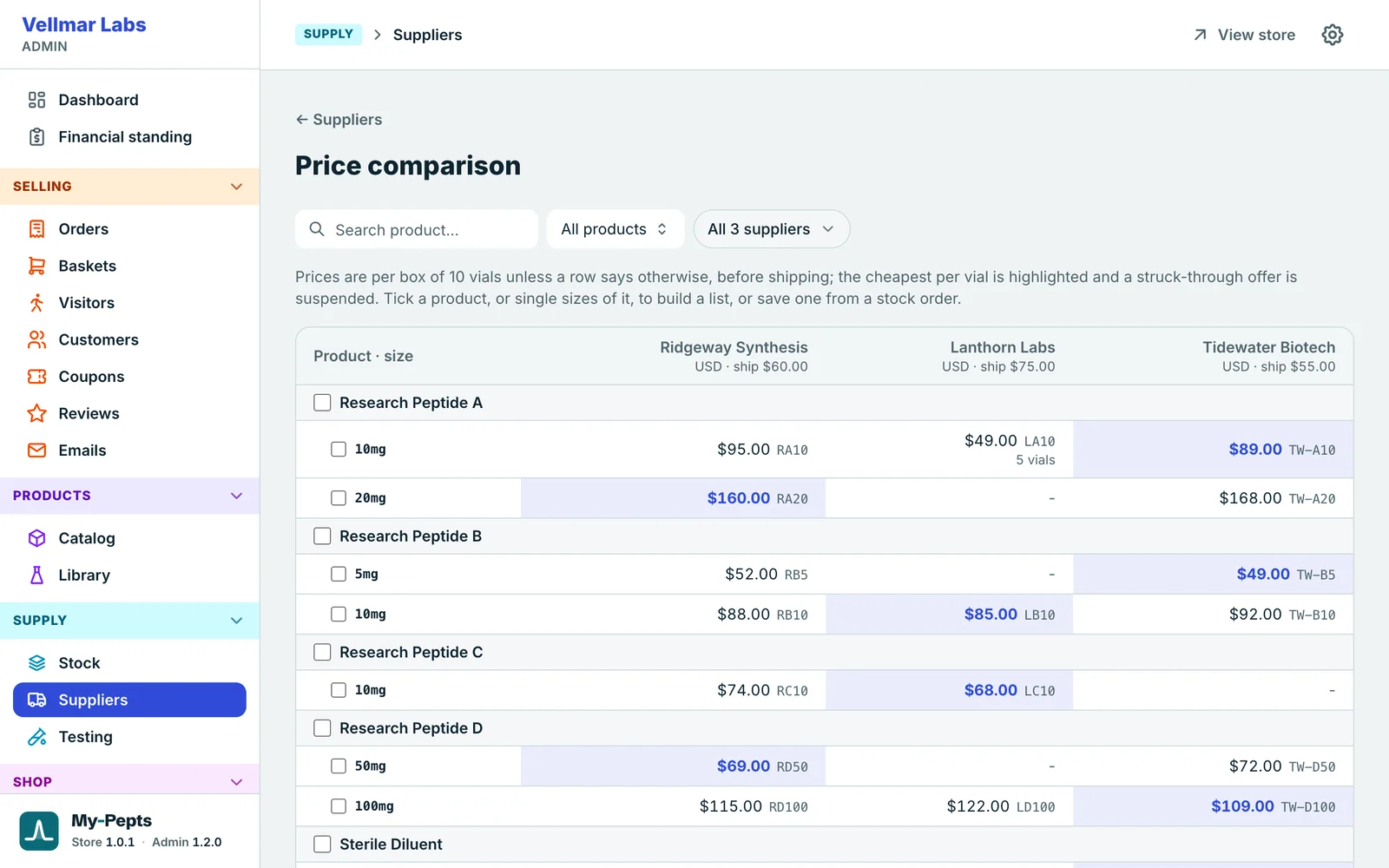
    The price comparison: Ridgeway Synthesis, Lanthorn Labs and Tidewater Biotech side by side, every size on a row with each supplier's own product code, and the cheapest per vial highlighted on each row. A box of five vials at $49 is not marked cheapest, since $9.80 a vial is more than $8.90.
  3. 03

    Check the certificate with the lab that issued it

    Ask for the certificate of the exact batch you will receive. Then check two things yourself: the lot number on the certificate matches the one on the vials, and the lab confirms the report is theirs, on its website or by email.

    The check: The same lot on the certificate and the vial, and the lab confirms the report.

    Practice on a certificate

  4. 04

    Start with a small order, paid in a way you can trace

    Order a small quantity first, even if the price per vial is worse. Pay with a method that leaves you a dispute route, and keep the quote, the invoice and every message.

    The check: A written quote, a payment you can dispute, and tracking on the parcel.

    In My-Pepts: Turn the supplier's quote into a stock order with the total checked against it, then follow the parcel through customs.Growth and up
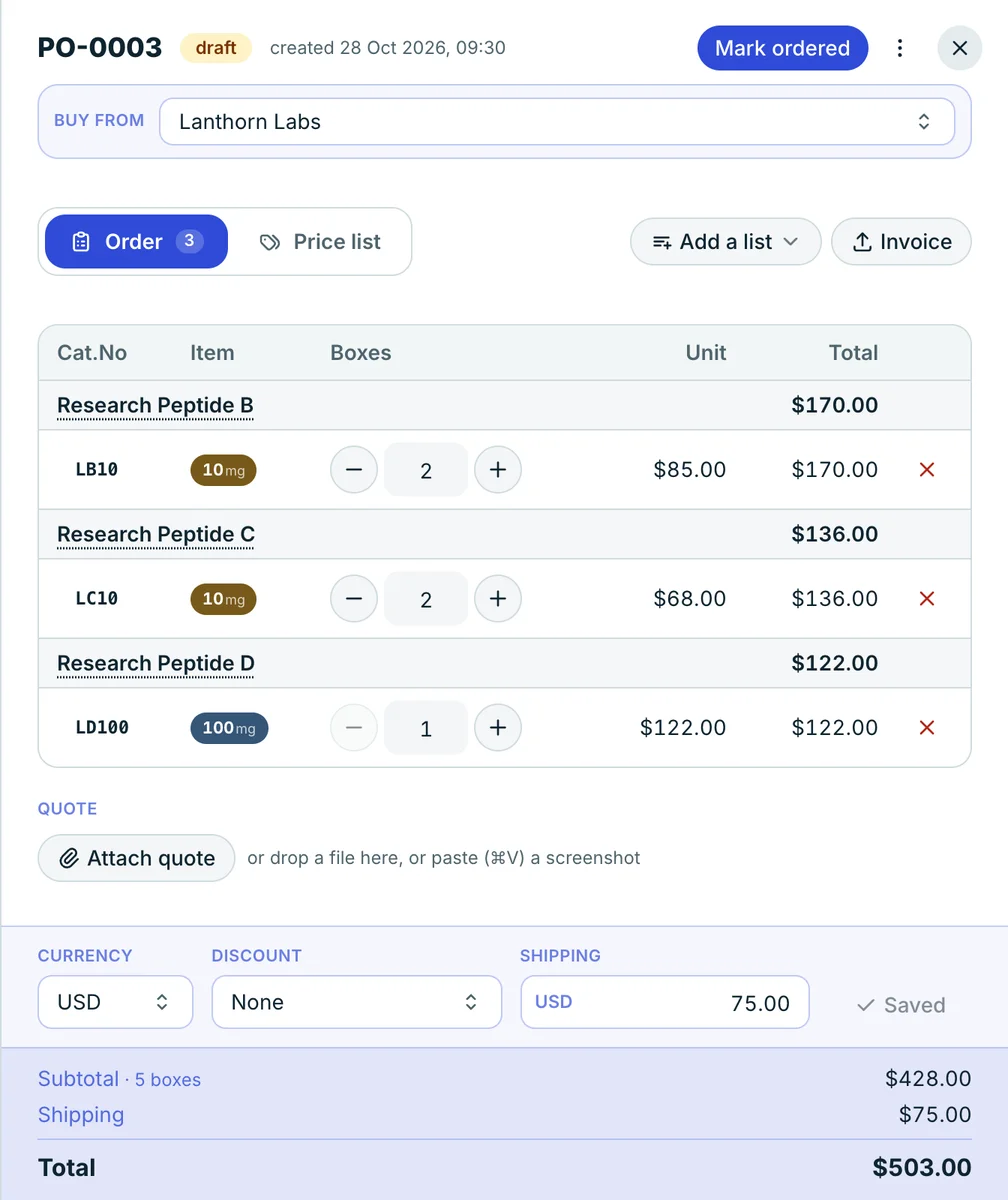
    A draft stock order to Lanthorn Labs with the supplier's quote attached: three lines with their product codes, boxes and unit prices copied from the quote, shipping of $75 and a total of $503.00 that matches the quote. The order is still a draft, with Mark ordered at the top.
  5. 05

    Book the delivery in, batch by batch

    Count it in on the day it arrives. Record each batch by its label and cap color, and file the supplier's certificate on that batch, so you can always say which customer got which vial.

    The check: Every vial on the shelf belongs to a recorded batch.

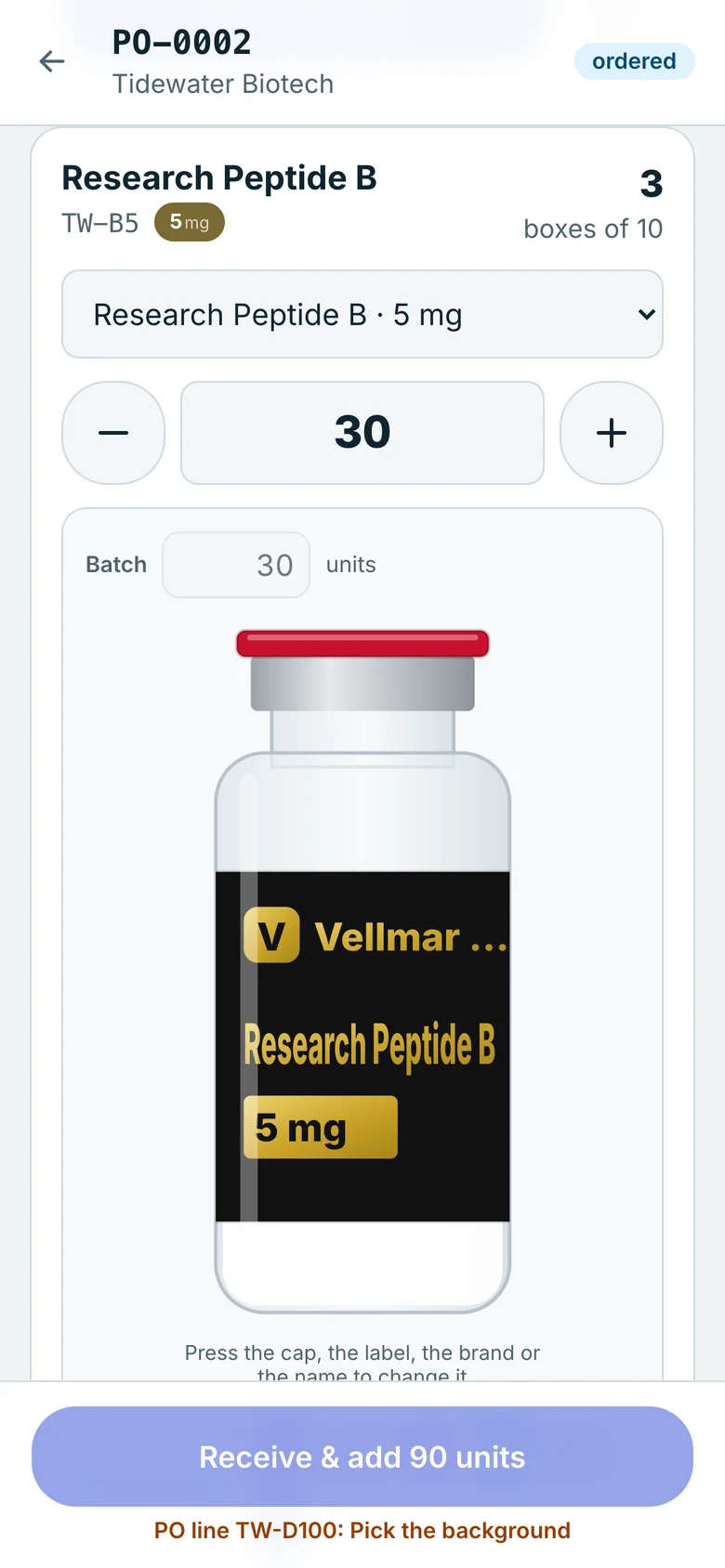
    In My-Pepts: Scan the order on your phone and photograph the boxes; the counts, caps and batch dates are filled in for you to confirm.Growth and up

  6. 06

    Send one vial to an independent lab

    Pick a vial at random from the delivery and send it for identity, purity, the amount in the vial and, ideally, endotoxin. Your own result for your own vial is the only one that is fully yours.

    The check: An independent result for this batch that agrees with the supplier's certificate.

    In My-Pepts: Testing rounds track each vial you send, what it cost and what came back, and file the result on its batch.Growth and up
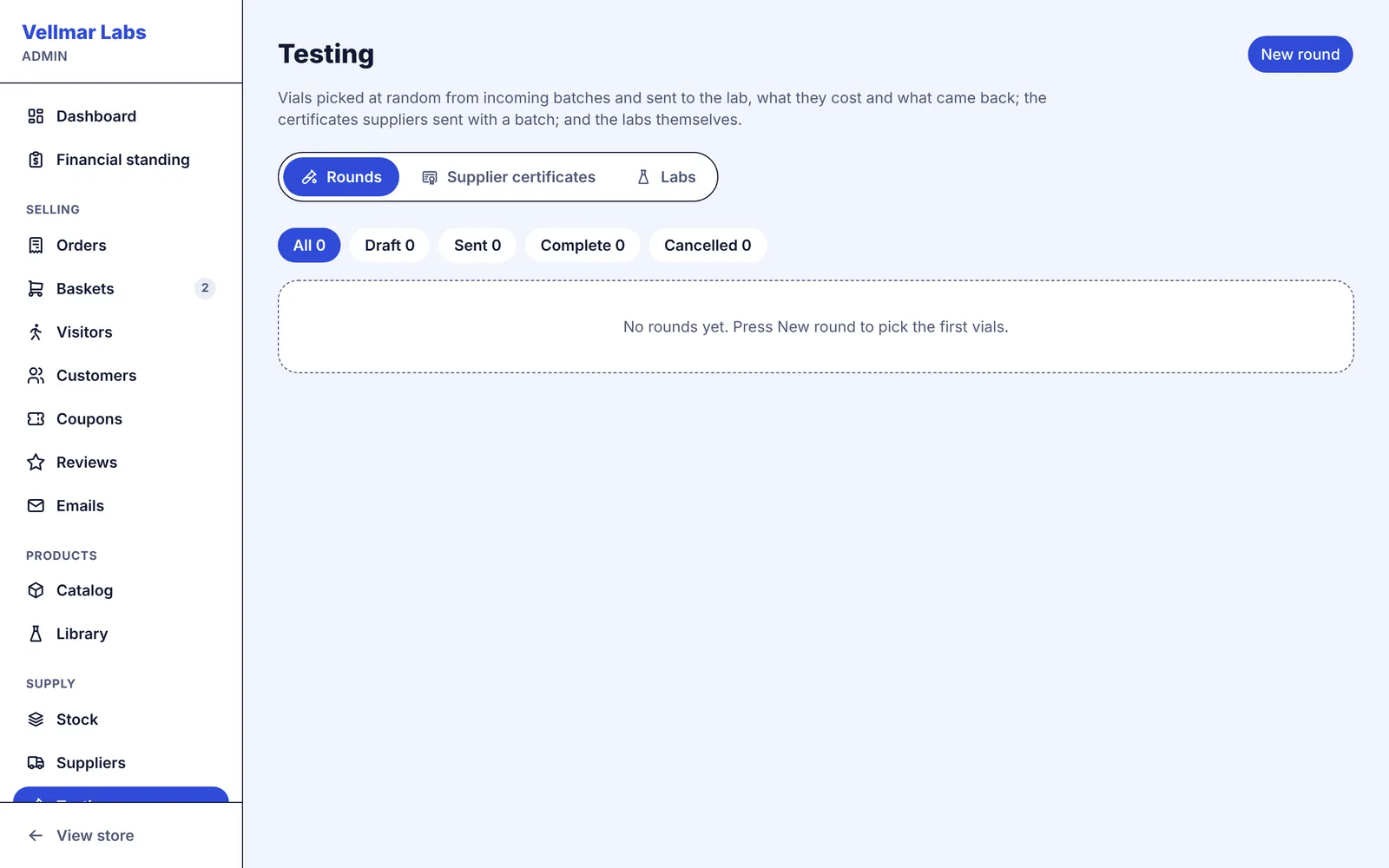
    The Testing page in a lab's admin, with tabs for testing rounds, the certificates suppliers sent and the testing labs, and a New round button.
  7. 07

    List the batch with its certificate, and not before

    Only now does the batch go on sale, with the certificate you hold for it. If your result and the supplier's disagree, believe yours, and talk to the supplier before you sell a single vial.

    The check: The certificate customers see covers the batch they will receive.

    In My-Pepts: Product pages show a blurred picture of the certificate and the full one on request, and never name the supplier.
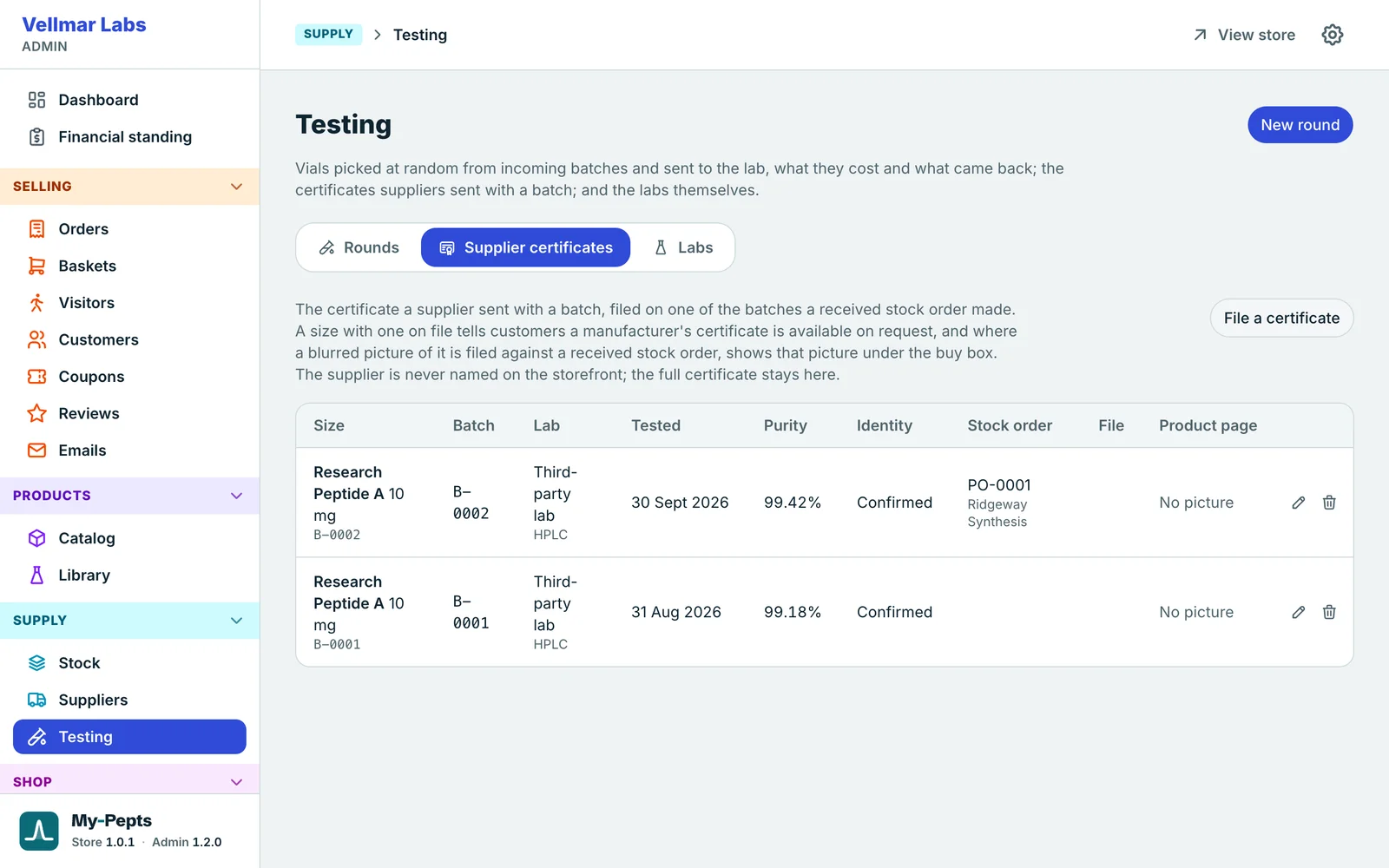
    The Testing page's Supplier certificates tab: a certificate for each batch of Research Peptide A 10 mg, with the lab, the test date, the purity (99.42% and 99.18%), identity confirmed and the stock order the batch arrived on.

Do the math

Is testing every batch worth it?

Move the sliders to your own numbers. The example uses $250 for a test, about what one US service charges for identity, purity, amount and endotoxin.[24]

If this batch turns out bad

Sold untested

$2,680

40 customer orders received a bad vial

Tested first

$2,650

0 customer orders received a bad vial

Stock written offShipping paidThe test

Refunds aren’t counted: they hand back money the sale brought in, which the tested batch never took.

Testing this batch costs 11% of what you paid for it. It rarely saves the stock. What it saves is the line the dollars leave out: customers who never get a bad vial, a bank or payment provider with no complaints to look into, and a name nobody has a reason to warn others about.

Summing up

Where My-Pepts helps, and where it doesn't

We do

  • Your store, live in minutes, with its own database, admin, brand, domain and email
  • Supplier price lists matched to your products from a screenshot, PDF or spreadsheet (Growth)
  • Stock orders checked against the supplier's quote, and parcels followed through customs (Growth)
  • Deliveries booked in by batch and cap color, from your phone (Growth)
  • Testing rounds that file every result on its batch (Growth)
  • Certificates on product pages, with the supplier never named
  • A list of suppliers we have vetted, and side-by-side price comparison (Scale)

We don’t

  • Supply stock, or guarantee any supplier, including those on our trusted list
  • Test vials: an independent lab does, and you choose it
  • Give legal, tax or import advice for your country
  • Decide what your store says: the wording is yours

Questions labs ask

Short answers. The sections above have the detail.

How long does it take to start a research peptide store?

With My-Pepts, about 20 minutes of your own time: create an account, name the store, brand it, add your products, then connect a domain and email. The store is live on its own address within seconds of naming it, and the trial is free for 14 days.

Do I need my own peptide supplier?

Yes. My-Pepts runs the store and gives you the tools to buy well, but it doesn't sell stock. On the Scale plan, the trusted supplier list adds suppliers we have vetted, price list included, in one click.

Is a supplier's certificate of analysis enough?

No. A certificate is the supplier's claim about one batch. Ask for the certificate for the exact batch you will receive, confirm it with the lab that issued it, check that its lot number matches your vials, and send one vial to an independent lab before you list the batch.

How much does independent peptide testing cost?

One US testing service charges $249 per sample for identity, purity, amount and endotoxin, with results in about two weeks, and a basic purity panel from $69. Prices vary by lab and country, and the UK labs we looked at quote on request.

How should I pay a new supplier?

Start with a small order, paid with a method that leaves you a dispute route, and keep the quote, the invoice and every message. Wires and crypto are hard to recover: the FBI can sometimes freeze a wire, but only when it is reported quickly.

Does a research use only label protect my store?

Not on its own. Regulators in the US and the UK look at everything a store says and sells, not just the label: the FDA's warning letters pointed to disease claims, dosing guidance, dose calculators and mixing supplies sold alongside. Research use has to be true of the whole store, not just printed on it.

What is endotoxin, and why does it matter?

Endotoxins are fragments of bacterial cell walls that stay in a product after the bacteria die. You can't see them, and many basic tests leave them out, so ask for an endotoxin result on every certificate and include it when you test.

Sources

The numbers in brackets point here. Rules and policies change; check the source before you rely on one. This guide is general information, not legal advice.

  1. 1.Warning letter to NuScience Peptides LLC · US Food and Drug Administration, August 24, 2026. One of five letters to research peptide sellers that day
  2. 2.RUO-ined: Five Peptide Vendors Learn That 'Research Use Only' Is Not a Legal Strategy · ArentFox Schiff, September 18, 2026. Law firm summary of the August 2026 warning letters
  3. 3.Grey-market peptides: what pharmacists need to know · The Pharmacist, April 12, 2026. Quotes the MHRA's head of borderlines on research-purpose claims
  4. 4.Bypassing prescribers and pharmacists: online purchasing of [two GLP-1 class peptides] 'for research purposes' · Annals of Pharmacotherapy (Belcourt, Ly and White), online September 17, 2024. A review of 40 websites
  5. 5.Prohibited and restricted businesses · Stripe, updated September 22, 2026
  6. 6.Import a human medicine · GOV.UK (MHRA), updated January 29, 2025
  7. 7.Safety and risk assessment of no-prescription online [GLP-1 class] purchases · JAMA Network Open (Ashraf, Mackey and others), August 1, 2024. Peer-reviewed research letter: six test orders, tested in a lab
  8. 8.Test your peptides at Krause Analytical · Finnrick, accessed November 1, 2026. Pass rate of the latest 200 published results; the samples are sent in by buyers, not chosen at random
  9. 9.2025 Internet Crime Report · FBI Internet Crime Complaint Center, April 2026. Non-payment and non-delivery figures, and the Recovery Asset Team
  10. 10.APP fraud reimbursement protections · Payment Systems Regulator (UK), accessed November 1, 2026
  11. 11.University lab tests of three vials sold as an experimental peptide · CBS News, October 21, 2026. News report; three samples, not peer-reviewed
  12. 12.United States v. Matthew Kawa · US Attorney's Office, Northern District of Indiana, updated August 3, 2026. Case page: the plea, the sentence and what the products contained
  13. 13.Medical Product Alert N°2/2024: falsified [GLP-1 class] pens · World Health Organization, June 19, 2024
  14. 14.Bacterial endotoxins/pyrogens (Inspection Technical Guide 40) · US Food and Drug Administration, 1985, still published
  15. 15.Pyrogenic reactions and hemorrhage associated with intrinsic exposure to endotoxin-contaminated intravenous solutions · Infection Control & Hospital Epidemiology (Daufenbach and others), 2006. An outbreak in five hospitals; intravenous solutions, not peptides
  16. 16.About 5,000 peptide shipments seized in Ohio · WHIO-TV, April 1, 2026. Reporting a US Customs and Border Protection release from Cincinnati
  17. 17.Fishy peptide freight: what Q1 2026 import data reveals · Partnership for Safe Medicines, June 9, 2026. Analysis of FDA import screening data for declared peptide shipments
  18. 18.Administrative destruction of certain drugs refused admission to the United States: final rule · US Food and Drug Administration, September 15, 2015
  19. 19.Options when customs seizes your things · GOV.UK, accessed November 1, 2026
  20. 20.Global crackdown on illicit pharmaceuticals sees USD 15.5 million in seizures · Interpol, May 7, 2026
  21. 21.Q7: Good manufacturing practice guide for active pharmaceutical ingredients · ICH, November 2000. Sections 7.3 (testing what you buy, including an identity test on every batch) and 11.4 (certificates of analysis)
  22. 22.Verify a certificate · Finnrick, accessed November 1, 2026
  23. 23.August 3, 2026: Peptide vendor sentenced to six years for 'incredible trail of harm' · Partnership for Safe Medicines, August 3, 2026. Reports what prosecutors said about forged laboratory certificates in the same case
  24. 24.Peptide testing: options and prices · Finnrick, accessed November 1, 2026. One US testing service's published prices

The easy part, done for you

Your store, your admin and the tools to buy stock with care, in one place.

Start your 14-day trial